
Advisory Committee
Ousol for Economic and Sustainable Development (OESD)
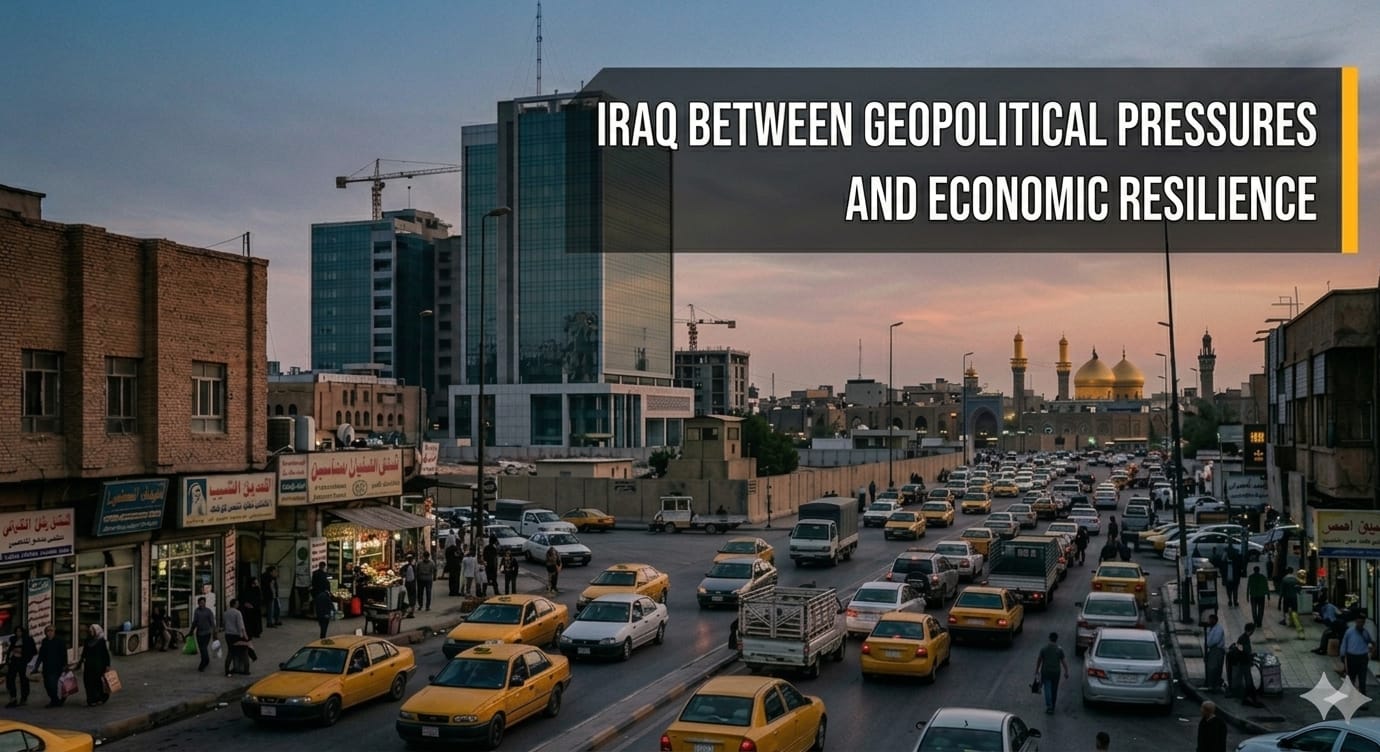
Iraq Between Geopolitical Pressures and Economic Resilience:
Why the Cost of Remaining in the Market Is Becoming Higher Than the Cost of Leaving It
The economic challenges confronting Iraq are no longer defined solely by oil prices or public spending capacity. Increasingly, they are shaped by the country’s ability to withstand a rapidly shifting regional and global environment marked by geopolitical instability, supply chain fragmentation, energy insecurity, and persistent inflationary pressures.
The global economy is entering a new phase in which economic resilience is becoming as strategically important as economic growth itself. International markets are gradually moving away from the era of low-cost hyper-globalisation toward models centred on supply chain security, industrial localisation, energy independence, and strategic economic self-sufficiency.
Iraq, however, remains heavily exposed to external shocks. Despite its substantial resource wealth, the Iraqi economy continues to operate through a structurally fragile model built around oil dependency, import-driven consumption, and limited domestic productive capacity.
Within this context, the Advisory Committee at Ousol for Economic and Sustainable Development (OESD), with the participation of OESD President Khalid Al-Jaberi, convened a series of discussions examining the growing pressures facing Iraq’s private sector and the broader structural risks threatening long-term economic stability.
The Committee concluded that Iraq is no longer facing a temporary market challenge. Rather, it is confronting a deeper structural test concerning the sustainability of its economic model itself.
The issue is not merely inflation, declining liquidity, or fluctuations in global energy markets. The real challenge lies in the country’s limited ability to absorb external shocks due to the absence of a sufficiently diversified and productive economic base.
Strong economies are capable of managing geopolitical volatility because they possess:
- diversified production systems,
- resilient private sectors,
- institutional adaptability,
- and strong domestic value chains.
Iraq, by contrast, remains heavily reliant on imports for:
- food supplies,
- raw materials,
- consumer goods,
- and even significant portions of its industrial and operational requirements.
As a result, any disruption in:
- energy markets,
- maritime trade routes,
- regional security dynamics,
- or international logistics networks,
immediately translates into domestic pressure on:
- prices,
- market confidence,
- purchasing power,
- and economic activity.
The Committee further warned that Iraq may be increasingly vulnerable to a gradual stagflationary environment — a condition in which inflation rises while economic activity slows and household purchasing power deteriorates simultaneously.
For rentier economies dependent on imports, this type of crisis is particularly dangerous because it places governments under dual pressure:
- rising living costs,
- alongside weakening market activity and declining productive momentum.
At the same time, the Committee stressed that many of Iraq’s internal economic difficulties are not solely external in origin. A significant portion stems from the structure of the domestic regulatory and administrative environment itself.
Today, the Iraqi private sector operates under compounded pressure generated by:
- bureaucratic complexity,
- overlapping regulatory authorities,
- inconsistent legal interpretations,
- unstable business regulations,
- and rising compliance costs.
Over time, the cost of operating formally within the Iraqi economy has, in some sectors, become disproportionately high relative to the benefits of remaining within the regulated system. This has contributed to the continuous expansion of the informal economy, not merely as a form of evasion, but increasingly as an economic survival mechanism.
The Committee noted that current economic policymaking in Iraq remains excessively focused on short-term revenue extraction through:
- expanded fees,
- intensified collection measures,
- and growing administrative intervention,
without adequately considering the long-term impact on investment, productivity, and market confidence.
Economies do not achieve sustainable growth through continuous pressure on the market. They grow through the expansion of productive capacity, lower operational costs, regulatory predictability, and the strengthening of private sector confidence.
The Committee also emphasised that Iraq now stands at a pivotal historical moment. The regional tensions surrounding energy corridors, maritime chokepoints, and supply chains are no longer external developments detached from Iraq’s economy. They have become direct variables influencing domestic economic stability.
Given Iraq’s strategic geographic position, any disruption affecting:
- the Strait of Hormuz,
- regional trade routes,
- global energy flows,
- or geopolitical alignments,
will inevitably affect Iraq’s internal market conditions.
Yet despite these risks, the Committee believes Iraq still possesses a rare strategic opportunity.
The country holds several long-term structural advantages, including:
- a critical geographic position,
- vast natural resources,
- a large domestic consumer market,
- and a young and expanding population.
If managed effectively, these assets could position Iraq as a major regional economic and logistical hub over the coming decade.
However, such a transformation cannot occur without a fundamental redefinition of the state’s economic role.
The Committee stressed that the solution is neither the complete withdrawal of the state from the economy nor a return to rigid centralised economic management. Rather, Iraq requires a balanced model in which the state evolves from:
- a revenue-extracting authority,
- into a regulatory and developmental institution focused on enabling growth.
This requires shifting state priorities toward:
- reducing operational costs,
- simplifying procedures,
- improving regulatory predictability,
- supporting domestic production,
- and empowering the private sector as a partner in national stability.
The Committee further stressed that developing a genuine private sector is no longer simply an economic preference. It has become a strategic necessity directly tied to Iraq’s long-term social, political, and economic stability.
The Iraqi state has effectively reached the limits of sustainable expansion in public sector employment, while hundreds of thousands of young people continue entering the labour market annually. Under such conditions, the private sector is no longer optional; it is indispensable.
Accordingly, the Committee recommends several urgent strategic priorities, including:
- reducing legal and administrative compliance costs,
- accelerating digital transformation in government services,
- reassessing non-productive fees and financial burdens,
- supporting domestic industries,
- establishing effective social protection mechanisms for private sector workers,
- and transforming fiscal policy from a purely extractive approach into a flexible economic stimulus framework.
Finally, the Committee concluded that Iraq’s greatest risk is not the volatility of oil prices alone, nor even regional geopolitical instability. The deeper risk lies in the continued absence of a coherent economic model capable of transforming Iraq’s vast resources into:
- productive capacity,
- sustainable employment,
- economic sovereignty,
- and long-term national resilience.