
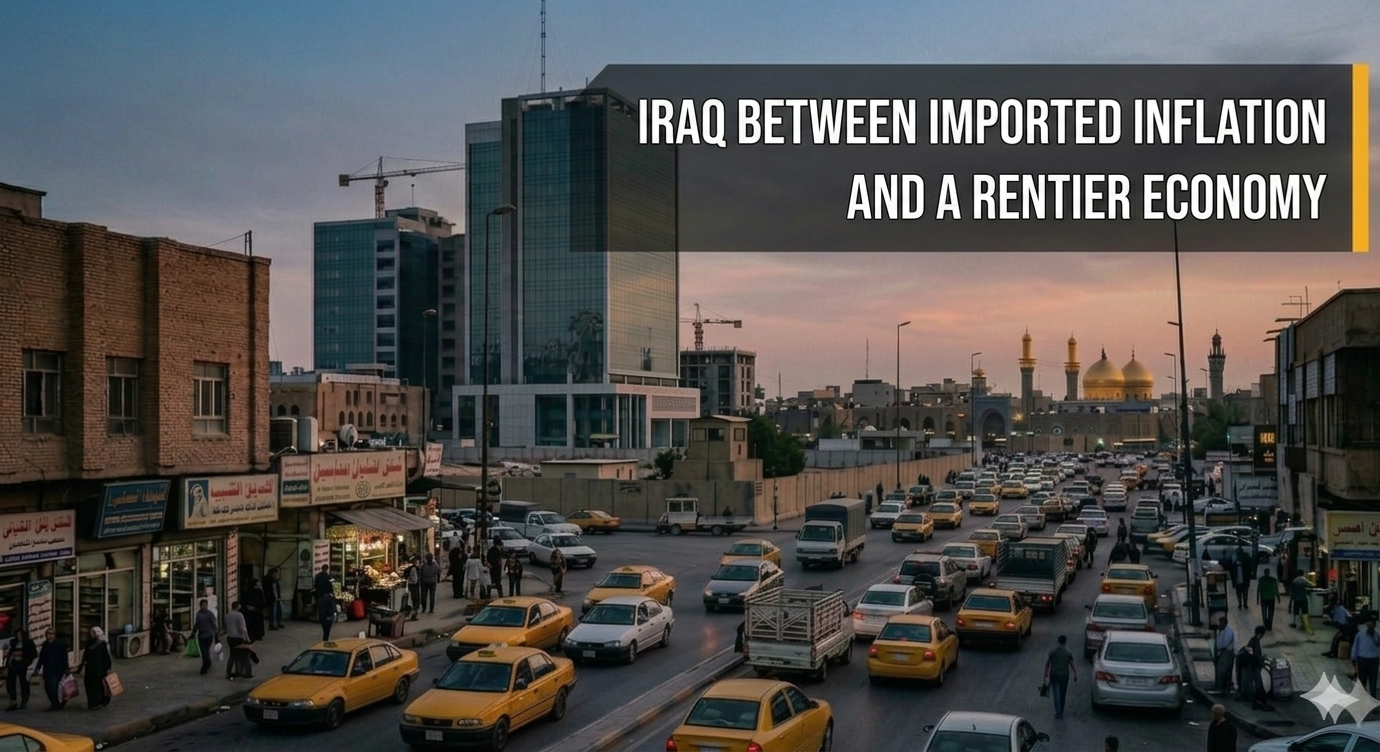
Iraq Between Imported Inflation and a Rentier Economy
By Khalid Al-Jaberi
Inflation in Iraq is no longer merely a monetary phenomenon tied to local market dynamics or levels of liquidity and public spending. It has become a direct reflection of sweeping geopolitical and economic transformations that are reshaping global energy markets, trade routes, and supply chains. The world is now navigating a turbulent economic transition, and Iraq stands among the economies most vulnerable to external shocks.
Khalid Al-Jaberi, President of Ousol for Economic and Sustainable Development (OESD), explained that Iraq is currently facing what can best be described as “transmitted inflation” — an imported form of inflation carried into the country through trade, energy costs, transportation, insurance, and disrupted supply chains, rather than one generated solely by domestic monetary imbalances.
According to Al-Jaberi, the Central Bank of Iraq still retains a relative degree of control over domestic monetary inflation. The deeper problem, however, lies in Iraq’s near-total dependence on imports, which causes every increase in global production, transportation, or energy costs to pass directly into the Iraqi market and immediately appear in consumer prices.
The closure of the Strait of Hormuz, rising maritime shipping costs, escalating insurance premiums, and soaring global energy prices have all pushed the prices of raw materials and manufactured goods to new levels. These increases have been felt across Iraqi markets, from construction materials and electrical appliances to food products and pharmaceuticals.
Recent international estimates suggest that global consumers may face inflationary pressures ranging between 10% and 15% on average, while certain commodities could experience price increases exceeding 60% or even 70%, depending on the nature of the product and the structure of its supply chain.
Yet Iraq’s challenge, Al-Jaberi argues, is not limited to rising prices alone. The core issue lies in the absence of a productive economy capable of absorbing external shocks. Despite its vast resources, Iraq remains a rentier economy overwhelmingly dependent on oil revenues, while industrial, agricultural, and productive service sectors continue to suffer from structural weakness.
Even essential sectors such as healthcare and pharmaceuticals rely heavily on imports, leaving the Iraqi market fully exposed to any disruption in global supply systems.
A Crisis Economy Cannot Be Managed With a Revenue-Collection Mindset
Al-Jaberi stresses that the real challenge is not inflation itself, but the way the state manages the economy during periods of crisis. Crisis economies, he argues, require entirely different policy tools from those used during periods of stability and prosperity.
While many countries have moved to ease pressure on markets and stimulate economic activity, Iraq’s economic environment remains burdened by layers of taxes, customs duties, fees, and bureaucratic procedures that have severely constrained the private sector, particularly small and medium-sized enterprises.
Business owners in Iraq are not only struggling with higher import costs. They also face an extensive web of financial obligations, including municipal fees, licensing costs, civil defense requirements, commercial electricity tariffs, taxes, customs duties, certifications, and administrative approvals.
Under conditions of weak purchasing power and market contraction, these burdens become a powerful deterrent to economic activity, forcing many businesses to scale back or shut down altogether.
At the heart of Al-Jaberi’s argument is the need to move away from the concept of “maximizing state revenues” toward the broader objective of “maximizing the state economy.” In his view, the state should not treat the economy merely as a mechanism for extracting revenue, but as a system for production, employment, investment, and long-term development.
Successive Iraqi governments, he argues, have focused almost exclusively on financing the public sector and maintaining payroll obligations, while neglecting what he describes as “the forgotten son of the state” — the private sector — despite the fact that it is the primary engine capable of generating jobs, expanding economic activity, and broadening the tax base sustainably.
Imported Inflation Is Eroding Purchasing Power
Al-Jaberi believes the most dangerous aspect of inflation is not simply rising prices, but the gradual erosion of purchasing power.
Workers and public employees whose incomes remain fixed are facing continuously rising costs of living, while their salaries remain stagnant. As imported goods become more expensive, the gap between income and expenditure widens, leading to broad economic contraction within the domestic market.
He warns that Iraq is currently experiencing a dual crisis: internal economic stagnation combined with externally imported inflation — one of the most difficult economic conditions any country can face, because traditional policy tools become far less effective under such circumstances.
To address this challenge, Al-Jaberi calls for a complete restructuring of fiscal policy, including temporary reductions in taxes, customs duties, and fees to relieve pressure on markets and provide the private sector with enough flexibility to absorb part of the global inflationary wave.
A product that arrives in Iraq already inflated by global transportation and energy costs, he argues, should not then be subjected to additional layers of domestic taxes and fees, as the final burden inevitably falls on the Iraqi consumer.
From “Petrodollar” to “Petro-Computer”
Discussing broader global transformations, Al-Jaberi notes that many oil-producing nations have begun to realize that the traditional oil-dependent economic model is approaching its limits. As a result, they are redirecting oil revenues toward technology, artificial intelligence, data centers, and advanced manufacturing.
He describes this transition as a shift from the “petrodollar” era to the “petro-computer” era — where oil wealth is invested in building knowledge-based and technology-driven economies rather than relying solely on crude exports.
According to Al-Jaberi, the world is currently witnessing a redistribution of global production chains. Major powers are retaining strategic and advanced industries while relocating parts of manufacturing operations to countries with flexible regulations, strategic geography, affordable energy, and stable investment environments.
Iraq, however, remains largely outside this transformation — not because of a lack of resources or human capital, but because of rigid legislation, entrenched bureaucracy, and the absence of a long-term economic vision.
He emphasizes that technology always moves faster than legislation, and countries that wait for perfect legal frameworks before adapting to technological change risk falling decades behind global developments.
Foreign Investment Is Not a Luxury
In Al-Jaberi’s view, attracting foreign direct investment is directly linked to reducing inflationary pressure and strengthening economic resilience.
Every factory built inside Iraq and every industry localized domestically reduces dependence on imports, lowers pressure on foreign currency reserves, and limits the transmission of global inflation into the Iraqi market.
Yet discussions about foreign investment in Iraq remain largely confined to oil and energy sectors. Genuine foreign investment, by international standards, involves global corporations establishing production facilities, industrial operations, technology hubs, and supply-chain networks integrated into the world economy.
Al-Jaberi argues that Iraq has yet to present itself as a stable and competitive investment destination capable of attracting this level of investment, despite possessing enormous strategic advantages, including geography, natural resources, energy capacity, and a young population.
Foreign Reserves Are Not a Permanent Solution
On monetary policy, Al-Jaberi warns against excessive reliance on the Central Bank’s reserves to maintain economic stability. Foreign reserves, he argues, should remain emergency protection tools rather than long-term substitutes for structural economic reform.
He cautions that prolonged geopolitical instability or disruptions in oil exports could place Iraq under severe financial pressure, particularly given the country’s limited logistical alternatives, including insufficient pipeline infrastructure and a lack of national oil tanker capacity.
He also dismisses currency devaluation as a sustainable solution, describing it as a “painful surgical procedure” that may offer temporary accounting relief but eventually produces deeper and more damaging inflationary consequences.
Iraq Stands Before a Historic Opportunity
Al-Jaberi believes Iraq is now facing a defining historical moment. The country can either remain a rentier, consumption-based economy dependent almost entirely on oil and imports, or transition into a flexible, productive economy integrated into emerging global transformations.
Iraq possesses the human resources, geographic position, and natural wealth necessary to become a major regional economic hub. Achieving that, however, requires a fundamental shift in economic thinking — moving away from a revenue-extraction mentality toward a strategy centered on economic construction and productive growth.
Ultimately, Al-Jaberi argues, Iraq’s future should not depend solely on fluctuations in oil prices, but on its ability to build an economy capable of surviving and competing as global energy systems, markets, and technologies continue to evolve.