
An 11% Gap the Exchange Rate Cannot Close: Fix Transfers and Trust Before the Dinar
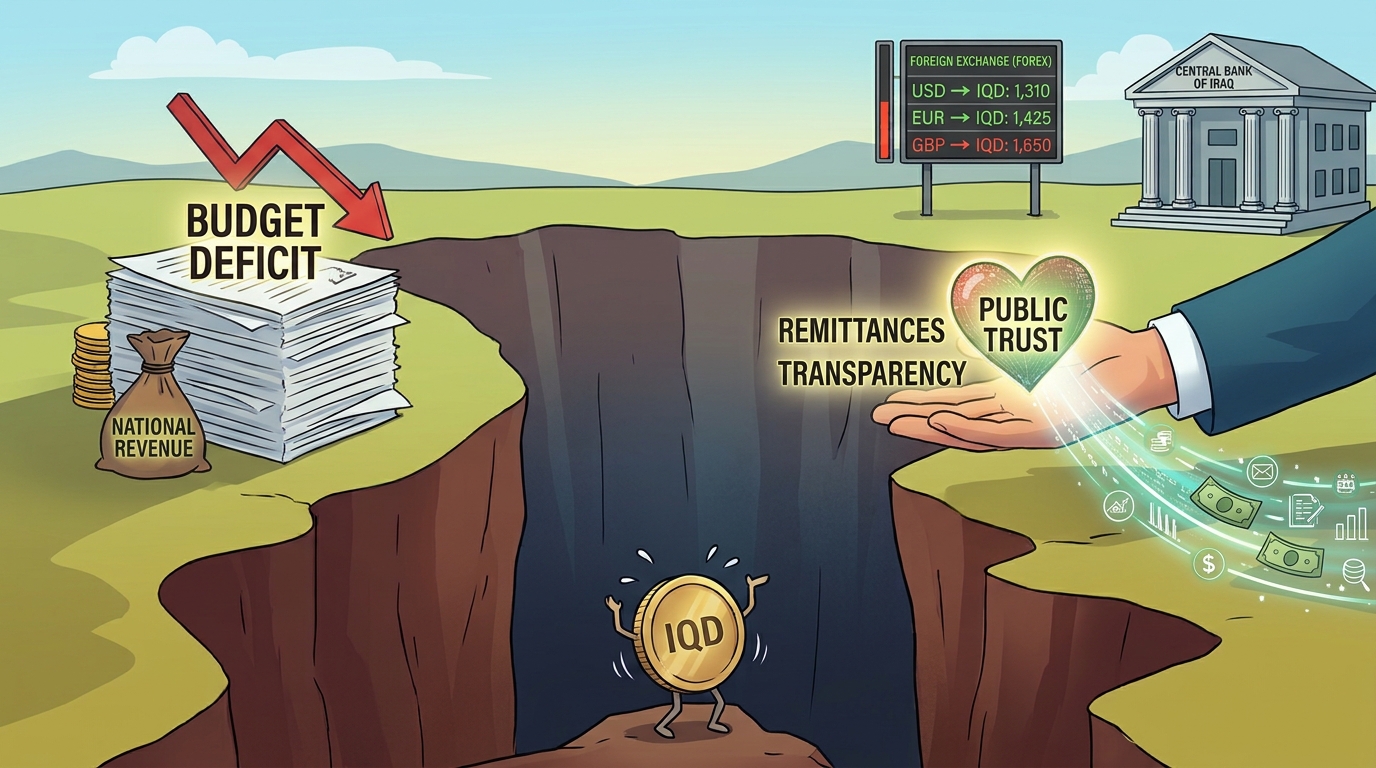
Iraq raised its official dollar rate by 15% to bring it closer to the market. The gap halved, but it did not close. The lesson is that Iraq’s black-market premium is a problem of plumbing and trust more than of price.
The problem in numbers
On 7 October 2026 a new official selling rate took effect: IQD 1,520 per dollar, up from IQD 1,320. All dollar equivalents below use the new official rate of IQD 1,520 per $1. A few weeks earlier, on 19 September, Baghdad’s exchange houses were selling $100 for IQD 160,250, a premium of 21% over the official rate.
On the first day of the new rate, the black-market price jumped to around IQD 178,000 per $100. By 31 October it had settled at IQD 168,500 against an official IQD 152,000. The premium today is roughly 11%, or IQD 16,500 (about $11) on every $100.
| Date (2026) | Official rate (IQD per $100) | Baghdad black market | Premium |
| 19 September | 132,000 | 160,250 | 21.4% |
| 7 October | 152,000 | 178,000 | 17.1% |
| 31 October | 152,000 | 168,500 | 10.9% |
Consumers pay twice. The dinar lost about 13% of its official value, and many traders still price goods off the black-market dollar. Sugar rose 15.4%, rice 10.8% and eggs 10.7% the day after the decision. One member of parliament put the rise in food prices at around 30%.
Diagnosis: why the gap persists
Iraq earns almost all its hard currency from one source, oil. The proceeds flow through the Central Bank of Iraq, which then sells dollars to banks and importers through its electronic “platform”. The gap is therefore not simply a shortage of dollars. It runs through three channels:
- A slow official channel: an external transfer takes weeks, so a trader in a hurry buys from the street. The cost of time becomes a price premium.
- Precautionary demand: the change came after repeated official denials in June, so many people now expect a second step and hoard dollars.
- An external shock: Brent reached about $117.6 a barrel on 30 October after a tanker was attacked in the Strait of Hormuz. Higher prices lift revenue, but they also remind everyone how fragile the export route is.
The result is an economy that is shrinking and inflating at once. The IMF expects Iraq’s real GDP to contract by 16% in 2026, with a current-account deficit of 10.8% of GDP. The trade-off is stark: every extra dinar the treasury gains from converting oil dollars is paid by consumers in the price of imports.
What the world says
Dual currency markets are not a technical detail. In a study co-authored by Carmen Reinhart, the World Bank’s former chief economist, average inflation between 1970 and 2001 was six times higher in countries with a black market for foreign exchange, and per-capita income growth was less than half that of unified-rate countries. Of 28 economies with such markets in 2020, only one ranked above the 50th percentile for control of corruption.
The same work finds that fears of an inflation spike on unification are usually overstated, because the spike is short-lived, while distortions grow costlier the longer the black market survives. Iraq has gone half the way: it has moved the price, but it has not equalised access to the dollar.
The global backdrop is not forgiving. The OECD’s September 2026 interim outlook projects world growth of 2.9% and G20 headline inflation of 4.1% this year. In June the OECD warned that broad relief measures are costly, and called for support that is targeted at the most vulnerable and carries automatic sunset clauses once conditions normalise.
The World Bank’s 2026 report on subsidy reform goes further. Emerging and developing economies spent about 6.9% of GDP on subsidies in 2020–2024, more than on health and education combined. It notes that broad tax exemptions do not reach poor households who buy staples in informal markets, and that direct transfers work better.
Egypt offers the closest regional parallel. In February 2024 the IMF’s managing director criticised the country’s multiple exchange rates and urged a market-determined rate, at a time when inflation was running near 20%.
The consultancies’ reading
Deloitte’s Middle East Economic Monitor (MEcon, July 2026) shows that the shock is regional. Saudi real GDP contracted by 4.8% in the second quarter of 2026 as crude exports were disrupted, the UAE’s non-oil PMI fell to 50.8 in June, and polls pointed to an 8.1% contraction in Qatar this year. The difference is that Gulf economies entered the shock with deeper fiscal buffers and banking systems. Iraq entered it with a slow transfer channel and fragile banking trust. Buffers cannot be bought in a crisis, but the speed of the banking channel can be fixed within weeks.
The Iraqi view
The Iraqi diagnosis starts with a name. Mr. Khaled Al-Jabri, President of the Osoul Foundation for Economic Development and Sustainable Development, stated that Iraq has no parallel market, only a black market, “because the dollar has a single source, which is oil”. This matches the international literature: the premium is a symptom of a fault in the official channel, not an alternative market with supply of its own.
Al-Jabri pins down where the fault lies. A trader whose transfer is held up for two months ends up paying his workers’ wages out of his own pocket, then buys dollars on the street, and the price rises. Hence, in his view, the test is not announcing a measure but how fast it is carried out: “speed of implementation is the achievement”. He applies the same principle to customs clearance and tax clearance certificates; otherwise the black market grows.
On social protection, Al-Jabri converges with the OECD and the World Bank on targeting. He argues that there is “a stratum of society that cannot cope” and must be supported whatever the exchange rate. He proposes a voucher card: an electricity voucher handed to the owner of the neighbourhood generator (privately run diesel generators that fill the gaps in grid supply), whom the state compensates in kerosene, and a food voucher redeemable at discount in designated stores. That is a tool that supports people rather than prices, exactly as the World Bank recommends.
But Al-Jabri adds an Iraqi specificity. He calls indirect support “the important part”: lowering the customs valuation of staple goods by government decision, and a tax exemption passed by parliament. In an economy that imports most of its food and medicine, customs costs reach every household. The government moved partly in this direction when it exempted imported food and medicine from customs duties on 13 October.
Al-Jabri also warns that “the speed at which inflation spreads is more dangerous than inflation itself”. A trader whose costs rise but who cannot raise prices eats into his margin until he leaves the market, and inflation turns into unemployment. Here he parts company with the view that devaluation helps domestic producers: weakening the currency without a product sold for hard currency, he says, “will ruin people”; “you need a product to sell”.
That shifts the debate from the rate to the business environment. Anyone who wants to open a factory, he argues, should have “the licence in his hand within 72 hours”. He has previously stated that patch-up fixes such as changing the exchange rate postpone crises rather than solve them, and that fiscal leverage is “a smart mobilisation of assets and liquidity towards productive and job-creating goals”.
Voices from the field
The gap is, at bottom, a question of certainty. As guest Qutaiba Zaki, Senior Manager at Deloitte Middle East – Iraq, said in the episode “السياسات الضريبية في العراق بين التعقيد والرقمنة!” (Tax Policy in Iraq: Between Complexity and Digitalisation) of the Seed | Nmw podcast, the relationship between investors and government must rest on trust, stability and the absence of surprises, because “capital fears the unknown”. He was speaking about tax, but the same logic governs the dollar: whoever fears another sudden decision hoards hard currency as a hedge.
Recommendations
- Central Bank of Iraq: a published maximum time for completing an official transfer, with a weekly release of the actual average days and of the premium between the two rates. Tool: a public data dashboard on the bank’s website.
- General Customs Authority and General Commission for Taxes: a fast track for tax clearance and customs release for importers registered on the platform. Tool: an electronic link between the platform and border crossings.
- Council of Ministers and Ministry of Planning: a targeted support card for vulnerable households (generator electricity and food), with a fixed duration and a review after six months. Tool: the ration-card database (Iraq’s universal food-ration system) combined with an income test.
- Council of Ministers and Council of Representatives: fix the customs exemption on staple foods and medicine for an announced year, rather than an open-ended deferral. Tool: a decision with a list of goods and an expiry date.
- Government with research centres: prior consultation before any monetary or tax decision in the 2027 budget, because surprise is what feeds precautionary demand. Tool: a public white paper for discussion.
Conclusion
Raising the official rate closed half the gap in one move. The other half will not be closed by price, but by faster transfers, stable decisions and protection for those with no margin left. The indicator worth tracking every week is the number of days a transfer takes, not the exchange-house rate alone.
Why Osoul?
The Osoul Foundation for Economic Development and Sustainable Development is an Iraqi institution that links data to economic decisions. It combines monitoring of the Iraqi street, measurement of the views of people and firms, and comparison with the best international practice, to produce solutions that can be implemented.
- Daily monitoring and the weekly Iraq Economic Observatory: tracking what Iraqis discuss on the economy and services, and government decisions, linked to the regional and global context.
- Surveys and indices: the Business Outlook Survey, the Service Gap Burden Index, and periodic surveys built on established international survey methodologies.
- Knowledge from the field: a library of documented economic positions, and the Seed | Nmw podcast, which interviews leaders of Iraqi companies.
- Workshops and policy briefs: workshops with research centres and stakeholders, whose outputs become recommendations for decision-makers.
- Advisory and technical services for major companies and government agencies: data-based studies, diagnostics and reform proposals, including the dollar and black-market survey that measures what people actually pay.
Osoul’s work is available at www.ofesd.com and on its social media accounts.
Sources
- 964, “Iraq’s exchanges record 168 thousand”, 2026 — link
- 964, “Oil jumps above $117”, 2026 — link
- Al Jazeera Net, “After the Iraqi dinar devaluation, fears of rising prices”, 2026 — link
- Al-Mustaqila, “The dollar jumps to 178 thousand in Baghdad”, 2026 — link
- Banker News, “The Central Bank explains the rise in the exchange rate”, 2026 — link
- 1news, “From the dollar to the Iraqi table”, 2026 — link
- Hathalyoum, “MP: prices up 30%”, 2026 — link
- Hathalyoum/Shafaq News, “IMF expects Iraq’s economy to contract 16% in 2026”, 2026 — link
- HortiDaily, “Iraq eases vegetable import restrictions following currency devaluation”, 2026 — link
- OECD, Economic Outlook, Interim Report September 2026: Weathering Successive Shocks, 2026 — DOI
- OECD, Economic Outlook, Volume 2026 Issue 1: Under Pressure, 2026 — DOI
- World Bank, Hooked on Subsidies: The Case for Reform, 2026
- Farah Yacoub, Hamadeh & Reinhart, “The pitfalls of parallel currency markets”, World Bank blog, 2022 — link
- Deloitte, Middle East Economic Monitor (MEcon), July 2026 — link
- Egyptian Streets, “IMF Chief: Multiple Exchange Rates in Egypt are Disastrous”, 2024 — link