
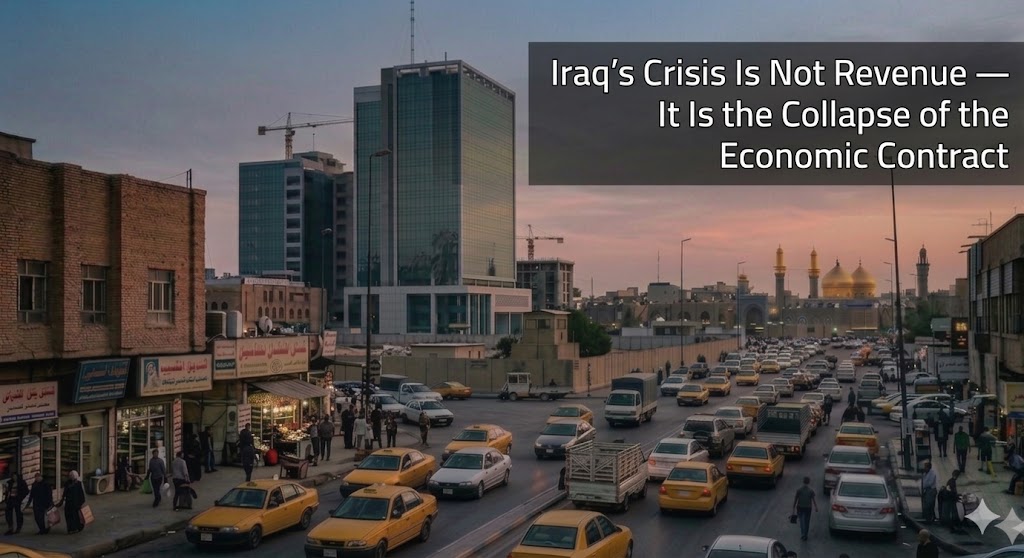
Iraq’s Crisis Is Not Revenue — It Is the Collapse of the Economic Contract
How oil transformed the relationship between the state and society from accountability to dependency
By Khalid Al-Jaberi
In functioning economies, the relationship between the citizen and the state is relatively straightforward:
citizens finance the state through taxation, and the state is held accountable for how it manages public money, services, infrastructure, and economic growth.
In rentier economies, however, the equation reverses itself entirely.
The state no longer depends economically on society.
Instead, society becomes increasingly dependent on the state.
This is where Iraq’s real crisis begins.
More than two decades after political change, Iraq remains trapped inside a deeply one-dimensional economic model overwhelmingly dependent on oil revenues, while failing to construct a parallel productive economy capable of generating sustainable growth, employment, exports, or long-term resilience.
The problem is no longer oil itself.
The problem is the economic philosophy built around oil.
Because oil did not merely finance the Iraqi state — it gradually reshaped the relationship between:
- the government,
- the market,
- society,
- and even public political behavior.
Iraq Never Truly Transitioned to a Market Economy
For years, Iraq has spoken the language of:
- privatization,
- private-sector development,
- investment,
- and economic diversification.
Yet structurally, the country never completed the transition from a centralized socialist economy to a genuine market economy.
What emerged instead was something far more distorted:
a consumer market operating inside a state-controlled economic mindset.
The market governs consumption behavior, but once investors, entrepreneurs, or businesses interact directly with the state, the old centralized system immediately reappears.
Large parts of Iraq’s economic framework still operate under legislation rooted in the era of the dissolved Revolutionary Command Council, while other regulatory structures date back to the 1950s and 1960s — periods when the state viewed itself as the sole producer, employer, planner, and controller of economic activity.
This contradiction defines modern Iraq:
a country attempting to operate a market economy through institutional machinery designed for state dominance.
The Dangerous Obsession With “Maximizing State Revenues”
One of the most damaging concepts embedded inside Iraq’s economic discourse is the repeated emphasis on:
“maximizing state revenues.”
At first glance, the phrase appears technical and harmless.
In reality, it reflects a profound misunderstanding of economics itself.
There is a fundamental difference between:
- maximizing revenues,
and - maximizing the economy.
States that focus on expanding their economies prioritize:
- productivity,
- investment,
- industrial activity,
- logistics,
- exports,
- and value creation.
States trapped in fiscal anxiety often choose the easier path:
more fees, more taxes, more levies, and more extraction.
Since 2015, Iraq’s fiscal approach has steadily drifted toward this second model.
Whenever public finances came under pressure, the state expanded:
- customs,
- administrative fees,
- taxes,
- penalties,
- and collection mechanisms.
But economies do not grow under excessive extraction — especially fragile economies.
Pressuring a weak private sector may temporarily increase collections, but over time it produces:
- tax evasion,
- shadow economies,
- capital flight,
- declining compliance,
- and shrinking formal economic activity.
In other words, the state begins collecting from an economy it is simultaneously weakening.
Iraq Is Trying to Tax a Small Economy Into Acting Like a Large One
Comparisons with Gulf economies are frequently used inside Iraqi policy discussions to justify increasing non-oil revenues.
But those comparisons ignore a critical distinction.
Gulf economies built broad economic ecosystems:
- logistics hubs,
- global investment platforms,
- tourism industries,
- financial services,
- energy value chains,
- and internationally integrated markets.
Iraq did not.
The Iraqi economy remains relatively narrow, consumption-heavy, import-dependent, and deeply tied to government spending.
This creates a dangerous contradiction:
Iraq is attempting to increase revenue extraction from an economy that remains structurally small and partially frozen.
The issue is not simply the tax rate itself.
It is the size and weakness of the economic base being taxed.
Which means additional fiscal pressure often pushes businesses toward:
- informality,
- concealment,
- or economic withdrawal altogether.
Iraq’s Private Sector Became a Contractor to the State — Not an Engine of Growth
In productive economies, the private sector generates:
- independent capital formation,
- innovation,
- exports,
- employment,
- and foreign currency inflows.
In Iraq, however, large segments of the private sector evolved into extensions of state spending.
Economic activity increasingly revolves around:
- government contracts,
- procurement cycles,
- public spending,
- and politically connected commercial ecosystems.
Instead of competing in productive markets, many businesses wait for:
- state tenders,
- government projects,
- or fiscal disbursements.
This is not merely a failure of entrepreneurship.
It is the natural outcome of an economic system that rewards proximity to the state more than productive risk-taking.
Even taxation itself is not the private sector’s primary complaint.
Businesses often describe the real burden as:
- bureaucratic unpredictability,
- conflicting regulations,
- administrative extortion,
- procedural complexity,
- and endless institutional friction.
The problem is not taxation alone.
It is the journey through the taxation system.
Oil Did More Than Finance the State — It Weakened Accountability
In tax-based economies, citizens demand accountability because they directly finance the state.
Taxation creates an unwritten political contract:
the citizen pays, therefore the government must justify performance.
Rentier systems dissolve this relationship.
When the state is overwhelmingly financed by oil exports rather than taxpayers, its economic dependence on society weakens.
And once this happens, the entire political economy begins to shift.
Citizens gradually become attached to the government as:
- an employer,
- a salary provider,
- a welfare distributor,
- or a source of contracts and financial access.
Meanwhile, the state becomes less economically dependent on citizens themselves.
This is one of the most dangerous long-term consequences of rentierism:
society slowly transforms from a productive class capable of monitoring the state into a financially dependent population reliant upon it.
Oil, in this context, becomes more than a commodity.
It becomes a mechanism that restructures social behavior, political incentives, and economic psychology.
Imported Inflation Will Expose Iraq’s Structural Weaknesses
For years, oil revenues concealed many of Iraq’s deeper structural problems.
But the global economy is changing rapidly.
Iraq now faces imported inflation driven by:
- rising global manufacturing costs,
- energy volatility,
- shipping disruptions,
- supply-chain fragmentation,
- and higher commodity prices.
The Central Bank can partially manage liquidity and exchange rates.
It cannot prevent imported inflation from entering a heavily import-dependent economy.
And once goods arrive in Iraq, additional layers of cost emerge:
- customs,
- fees,
- logistics inefficiencies,
- intermediaries,
- and weak domestic production capacity.
This creates a compounded inflationary environment that monetary policy alone cannot contain.
The deeper issue is that Iraq lacks a sufficiently productive local economy capable of absorbing external shocks.
Iraq’s Real Crisis Is Legislative and Institutional
Perhaps Iraq’s deepest structural problem lies inside its legal and institutional architecture.
The country operates under overlapping layers of:
- laws,
- instructions,
- directives,
- administrative controls,
- and conflicting regulatory interpretations.
In some cases, regulations contradict legislation itself.
The result is an environment where uncertainty becomes systemic.
Investors do not enter a transparent market governed by stable rules.
They enter a maze of approvals, interpretations, overlapping authorities, and discretionary enforcement.
Even Iraq’s decentralization efforts were implemented through old centralized legal frameworks dating back decades.
In effect, Iraq attempted to build a modern economic system using institutional software written for a completely different era.
Iraq Does Not Need More Extraction — It Needs a Larger Economy
Economies in crisis cannot be managed using the same tools designed for periods of abundance.
Iraq’s central question should no longer be:
“How do we collect more revenues?”
The real question is:
“How do we build a larger, more productive economy?”
Because nations do not become stronger by extracting more from weak societies.
They become stronger by expanding the productive capacity of the economy itself.
Iraq today does not merely require fiscal reform.
It requires a complete redefinition of the relationship between:
- the state,
- the market,
- society,
- and oil itself.
Because the most dangerous stage any rentier economy can reach is this:
when society becomes fully dependent on the state,
while the state no longer feels economically dependent on society.