
A IQD 43 trillion gap won’t be closed with phone credit: activity before collection in Iraq’s 2027 budget
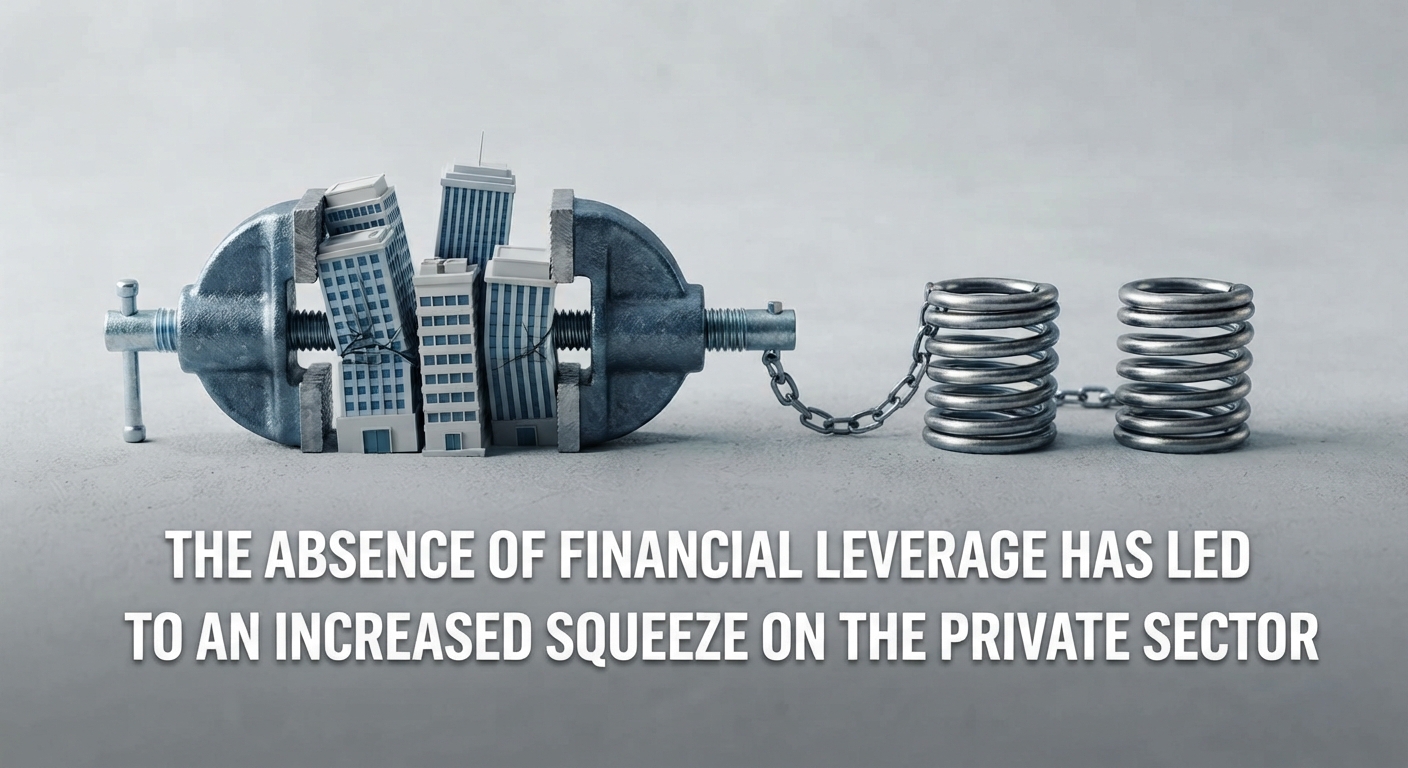
Iraq’s draft 2027 budget reaches the cabinet with a planned deficit of about IQD 43 trillion (≈ $28.3bn at the official rate of IQD 1,520 per dollar, used throughout), while November salaries remain unfunded. The central argument here is that closing this gap with levies on everyday consumption in a contracting year erodes the very base that is supposed to finance it.
Introduction: a late salary and a new levy
As of midday on 22 November 2026, funding for November public-sector salaries had not been released. The treasury pays about 15 million Iraqis directly — employees, retirees and social-protection beneficiaries — at an estimated cost of IQD 8 trillion (≈ $5.3bn) a month.
In the same draft, spending is about IQD 217.2 trillion (≈ $142.9bn) and revenue about IQD 174.2 trillion (≈ $114.6bn). Of that, IQD 127 trillion comes from oil exports, IQD 17 trillion from sales to refineries and IQD 30.2 trillion from non-oil sources, about 19% of the total.
To reach the non-oil target, the draft proposes fast-yielding instruments:
| Proposed instrument | Amount or rate | Who pays |
| Levy on each outbound air ticket | IQD 25,000 (≈ $16) | Every air traveller |
| Fee at airports and land crossings | IQD 10,000 (≈ $6.6) | Every traveller |
| Sales tax on internet, mobile credit and restaurants | 10% | Almost every household |
| Taxes on private clinics, gyms and home-based businesses | Unspecified | Small and home businesses |
These come on top of the 20% charge consumers have paid since March 2026 on mobile credit and fibre-to-the-home subscriptions. The 10% tax would be stacked on an existing levy, not imposed on a clean slate.
Diagnosis: a liquidity crisis treated with the wrong structural tool
The root of the squeeze is external. Shipping through the Strait of Hormuz runs at a seven-day average of 7.9 transits a day, against 85 before the war, and seven tankers have been hit since 16 November. Basrah Heavy sells at a discount of about $42 to Brent, while oil funds more than 90% of the budget.
The result is a monthly liquidity gap that the Central Bank of Iraq covers from reserves, which fell to about $75bn in mid-October from $78.2bn at end-September. With no approved budget for two years, spending runs on a monthly one-twelfth basis: contractor payments are deferred and demand contracts.
This is the core trade-off. A consumption levy is quick to collect and easy to administer, but it is regressive: it takes the same amount from a poor household as from a well-off one. In a contraction, the taxable base itself shrinks — a household downgrades its package, a traveller switches to the road, a home business slips into the informal economy.
There is a third, less visible channel: trust. A citizen whose salary arrives late, and who pays out of pocket for the neighbourhood generator, drinking water and medical care, sees no return for the new levy. Where trust is absent, evasion rises and actual collection falls short of plan.
What the world says
The OECD distinguishes between kinds of revenue measures. When its members sought extra revenue in 2025–2026, they mainly broadened bases, trimmed exemptions and raised targeted excises such as tobacco. The stated rationale is that these tools limit short-term damage to investment and labour markets.
The OECD’s Foundations for Growth and Competitiveness 2026 goes further: growth-enhancing reforms improve debt dynamics without relying exclusively on fiscal consolidation. Its three levers are broader tax bases, more efficient government and a more dynamic economy. Its 2026 review of tax administration digitalisation shows that e-invoicing now enables pre-filled VAT and corporate returns.
Vitor Gaspar and colleagues at the IMF (2023) identify a tax-to-GDP ratio of about 15% as a threshold beyond which growth accelerates. But their route there is institutional capacity, digital compliance and fewer exemptions, with evidence presented to the public to win acceptance. Mark Blyth, author of Austerity: The History of a Dangerous Idea, warns that austerity in a downturn deepened Europe’s slump in the 2010s, and that it has returned as a tool for shifting costs onto particular groups.
The consultancies’ reading
Deloitte Middle East, in its April 2026 note on the employment-tax filing season in Federal Iraq, records that returns must be lodged on paper at the General Commission for Taxes, with a wet stamp and signature. The Commission had to grant an exceptional approval for scanned copies, stressing that it sets no precedent, and it is operating with fewer inspectors.
This is the machinery now expected to collect a sales tax across millions of small transactions. PwC Middle East, in its 2025 regional tax survey findings, urges organisations to move beyond legacy systems and manual processes. The shared conclusion is that Iraq’s binding constraint is tax administration, not the tax rate.
The Iraqi view: activity before collection
Mr. Khaled Al-Jabri, President of the Osoul Foundation for Economic Development and Sustainable Development, stated that “the state does not maximise its revenue… the state maximises its activity.” In his view, the revenue-maximisation philosophy that began around 2015–2016 turned into raising the fee on the same service, until “the cost of compliance became higher than the cost of evasion.” This converges with international warnings about regulatory burden, and adds an Iraqi diagnosis of where the problem began.
Al-Jabri considers the draft’s taxes on mobile phones, restaurants and people working from home to be wrong, because in a contraction the right move is to “give expansion.” Here he parts ways with OECD members that remove consumption exemptions: those are growing economies, while Iraq’s market is contracting and its public services are deficient.
Al-Jabri cites Imam Ali’s instruction to Malik al-Ashtar — that concern for developing the land should outweigh concern for collecting the land tax — and renders it in modern terms: create economic activity and the tax will follow. Collection, for him, falls on activity rather than on revenue, and the private sector is willing to pay “through reasonable mechanisms.”
He offers alternatives from within the system, consistent with the international emphasis on government efficiency: link more than 30 administrative collection units to the Treasury Single Account and end departmental self-financing; waive fines and interest on tax arrears while keeping the principal; and defer tax or reduce direct withholding for a band of companies for 2026. He notes that chasing home-based workers costs more in administration than it raises, because their income usually falls below the tax allowances.
On salaries, Al-Jabri argues that the solution is to “re-engineer how the dinar is spent”: households spend about IQD 665,000 (≈ $438) a month on seven basic services that the relevant ministries fail to deliver adequately. Citizens thus pay an undeclared tax before any new levy. He sums up his position: a successful economy rests not on higher taxes, but on smart management that achieves growth before revenue.
From the field
As guest Qutaiba Zaki, Senior Manager at Deloitte Middle East – Iraq, said in the episode “السياسات الضريبية في العراق بين التعقيد والرقمنة!” (Tax policies in Iraq between complexity and digitalisation) of the Seed | Nmw podcast: between raising rates and broadening the base, the right course for the government is “broadening the tax base while providing a fair tax system.” He argues that evasion in Iraq stems from the absence of any felt return in services and from many people not knowing how to pay, and that e-invoicing linked to banks, customs and the General Commission for Taxes is the remedy, as in Egypt and Saudi Arabia.
Recommendations
- Ministry of Finance: separate the salary funding schedule from budget negotiations and publish the funding date monthly on its website, to reduce precautionary dollar demand and household borrowing.
- Council of Ministers: suspend the 10% sales tax on internet and mobile credit and the travel levies through a transitional article in the budget law, triggered only when quarterly consumption growth returns.
- Ministry of Finance and the Federal Board of Supreme Audit: link all collection units to the Treasury Single Account within six months, and publish what each unit collects every quarter.
- Minister of Finance: issue a decision waiving fines and interest on tax arrears, conditional on paying the principal within a set period.
- General Commission for Taxes: introduce e-invoicing linked to banks and customs, starting with medium and large companies, and electronic filing in place of the wet stamp.
- Parliament’s Finance Committee: require a published estimate of every new tax or fee’s impact on household income by bracket, and on expected yield, before the vote.
Conclusion
Iraq’s deficit is a problem of oil, liquidity and trust, not of phone credit. While activity is contracting, every dinar collected from everyday consumption will be paid back in deeper contraction and wider evasion. Broadening the base through digitalisation, disciplining existing collections and paying salaries on time is the path where international experience and Al-Jabri’s argument meet: activity first, then collection.
Why Osoul?
The Osoul Foundation for Economic Development and Sustainable Development is an Iraqi institution that links data to economic decision-making. It combines monitoring of the Iraqi street, measurement of the views of people and businesses, and comparison with the best international experience, to produce actionable solutions.
- Daily monitoring and the weekly Iraq Economic Observatory: tracking what Iraqis discuss on the economy and services, and government decisions, set against regional and global context.
- Surveys and indicators: the Business Outlook Survey, the Service Gap Burden Index, and regular surveys built on established international survey methods.
- Knowledge from the field: a documented library of economic positions, and the Seed | Nmw podcast, which interviews leaders of Iraqi companies.
- Workshops and policy briefs: workshops with research centres and stakeholders whose outputs become recommendations for decision-makers.
- Advisory and technical services for major companies and government agencies: data-driven studies, diagnostics and reform proposals, including measuring the impact of taxes and fees on households and businesses.
The Foundation’s work is available at www.ofesd.com and on its social media accounts.
Sources
- Al-Mada, “2027 budget: a struggle over resources” (Arabic), 2026: https://almadapaper.net/460279/
- Alsumaria, “New taxes and fees in the 2027 budget” (Arabic), 2026: https://www.alsumaria.tv/infograph-details/581233/
- Shafaq News via Hathalyoum, “No funding yet for November employee salaries” (Arabic), 2026: https://hathalyoum.net/articles/4267854
- Shafaq News, “The salary state unsettles the 2027 budget” (Arabic), 2026: https://shafaq.com/ar/تقارير-وتحليلات/بسبب-15-مليون-عراقي-دولة-الرواتب-تربك-موازنة-2027
- Shafaq News, “Iraq’s 20% telecom tax sparks debate over economic burden on citizens”, 2026: https://www.shafaq.com/en/Economy/Iraq-s-20-telecom-tax-sparks-debate-over-economic-burden-on-citizens
- Shafaq News, “CBI reserves top 113 trillion dinars” (Arabic), 2026: https://shafaq.com/ar/Economy/CBI-reserves-top-113-trillion-dinars-after-devaluation
- now, daily transit count, 2026: https://hormuz.now/traffic · Iran International, “Seven tankers hit in Hormuz since Nov. 16”, 2026: https://www.iranintl.com/en/202611223290
- Business Today/Reuters, “Iraq offers crude at steep discounts”, 2026: https://www.businesstoday.in/world/story/hormuz-blockade-no-bar-iraq-offers-crude-at-steep-33-discounts-as-oil-markets-retreat-from-war-highs-568679-2026-11-20
- OECD, Restoring Public Finances, 2026: https://doi.org/10.1787/fbcf9161-en
- OECD, Foundations for Growth and Competitiveness 2026, 2026: https://doi.org/10.1787/40a7532f-en
- OECD, Digitalisation and Digital Transformation in Tax Administrations, 2026: https://doi.org/10.1787/5976063c-en
- IMF Blog, Vitor Gaspar, Mario Mansour, Charles Vellutini, “Countries Can Tap Tax Potential to Finance Development Goals”, 2023: https://www.imf.org/en/blogs/articles/2023/09/19/countries-can-tap-tax-potential-to-finance-development-goals
- Mark Blyth, “Austerity is back and more dangerous than ever”, Project Syndicate / The Jakarta Post, 2025: https://www.thejakartapost.com/opinion/2025/03/03/austerity-is-back-and-more-dangerous-than-ever
- Deloitte Middle East, “Conclusion of the annual employment tax filing season for fiscal year 2025 in Federal Iraq”, 2026: https://www.deloitte.com/middle-east/en/services/tax/perspectives/conclusion-of-the-annual-employment-tax-filing-season-for-fiscal-year-2025-in-federal-iraq.html
- PwC Middle East, “Tax in focus: Global Reframing Tax Survey 2025 — Middle East findings”, 2025: https://www.pwc.com/m1/en/publications/global-reframing-tax-survey-2025-middle-east-findings.html