
By Khalid Al-Jaberi
President of Ousol for Economic and Sustainable Development (OESD)
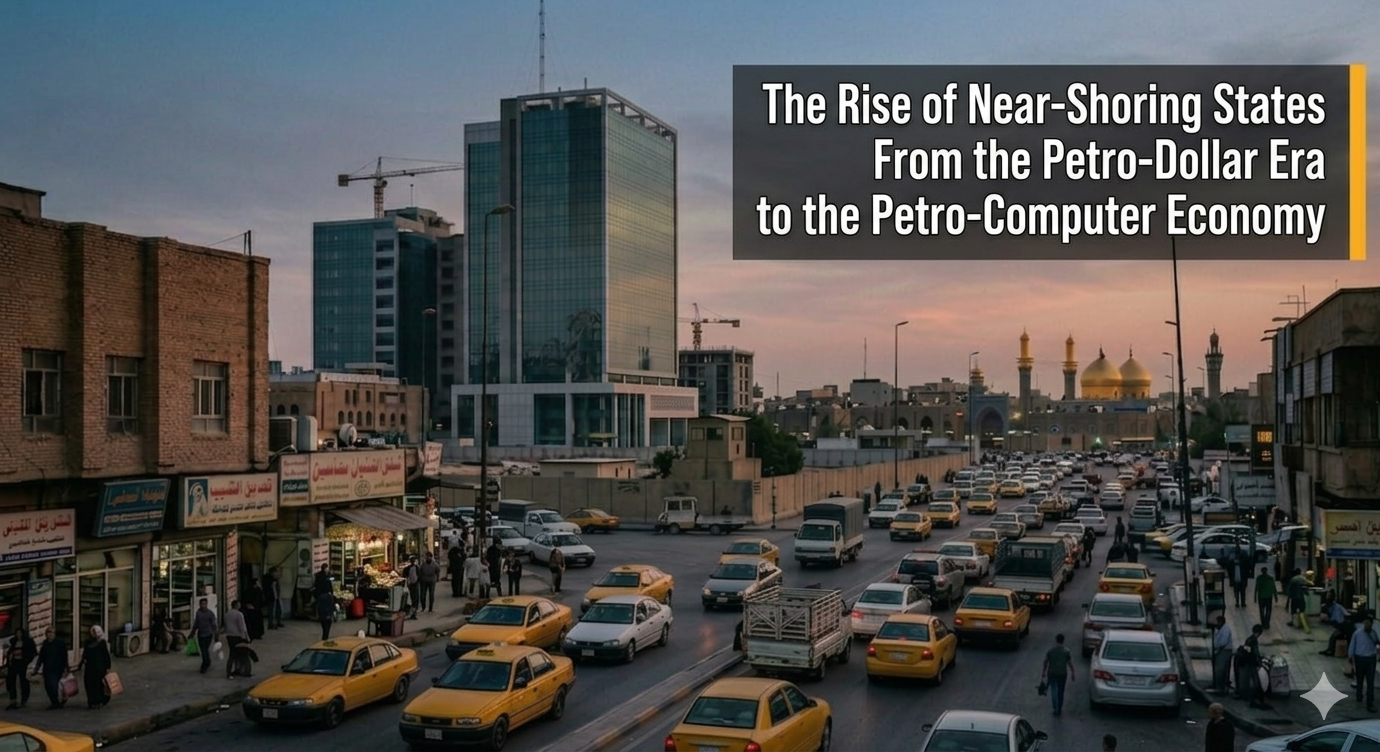
The Rise of Near-Shoring States
From the Petro-Dollar Era to the Petro-Computer Economy
In 2025, global foreign direct investment (FDI) flows rose to approximately $1.66 trillion, marking a 15% increase compared to 2024, according to OECD data. Yet this increase did not necessarily reflect balanced or sustainable growth as much as it reflected a profound repositioning of global capital within an increasingly volatile economic and geopolitical environment.
The world is no longer investing according to the same logic that shaped global markets over the past several decades.
The United States maintained its position as the world’s largest destination for foreign direct investment, attracting approximately $288 billion in 2025, followed by China with nearly $80 billion and Brazil with roughly $77 billion. At the same time, the United States was also the world’s largest outward investor, with overseas investment flows exceeding $310 billion, followed by Japan and China.
Behind these figures, however, global indicators reveal a far deeper transformation.
A significant portion of the growth in investment flows was not driven by traditional industrial expansion, but rather by:
- the restructuring of multinational corporations,
- intra-group financing and investment flows,
- and the strategic relocation of capital toward allied or more stable economies.
Meanwhile, new industrial investment across emerging markets experienced a sharp decline, with investment in manufacturing and industrial projects falling by nearly 44%. The bulk of global capital expenditure became concentrated in a limited number of countries, most notably:
- the United States,
- France,
- India,
- the United Kingdom,
- and Australia.
Looking ahead to 2026, international forecasts suggest that global uncertainty is likely to persist due to:
- escalating geopolitical tensions,
- energy market disruptions,
- the fragility of maritime trade corridors,
- and increasing market sensitivity to regional conflicts and supply-chain vulnerabilities.
This signals that the global economy is gradually entering a new phase — one defined not merely by growth, but by “economic resilience” and the ability to withstand disruption within a rapidly evolving political, technological, and financial order.
The world no longer operates according to the same economic principles that governed the post–Cold War era. The global economic system built upon open globalization, extended supply chains, and low-cost production has begun to fragment under the pressure of geopolitics, technological rivalry, energy instability, and mounting economic and security risks across the globe.
What we are witnessing today is not simply a temporary inflationary episode or a cyclical slowdown in the markets. It is the beginning of a historic transition toward a new global economic model that is redefining the concepts of:
- industry,
- energy,
- technology,
- supply chains,
- and even the very nature of the economic state itself.
The world has effectively entered the age of “geoeconomics,” where economic decisions are no longer shaped solely by cost efficiency, but increasingly by security, alliances, and strategic resilience.
For this reason, major economies — particularly the United States and Europe — have begun redesigning global production and investment maps according to standards fundamentally different from those that prevailed over previous decades.
The world that once searched for the “cheapest factory” is now searching for:
- the most stable environments,
- the most resilient states,
- and the economic systems most capable of safeguarding supply chains, energy security, and data infrastructure.
This transformation has given rise to concepts such as:
- Near-shoring,
- Friend-shoring,
- and Resilient Supply Chains.
These are not merely economic terms; they reflect the restructuring of the global economic order around alliances, economic flexibility, and strategic security.
Major powers no longer fully trust the model of unrestricted globalization, which left the global economy dangerously exposed to:
- geopolitical crises,
- wars,
- pandemics,
- disruptions in maritime routes,
- and shortages in energy, semiconductors, and advanced technologies.
As a result, the global economy is gradually shifting from an “economy of maximum efficiency” toward an “economy of strategic resilience.”
Within this transformation, the United States and Europe have not abandoned industry, as some believe. Instead, they have redistributed industry according to layers of value creation.
Western economies are now retaining the highest-value and most security-sensitive sectors, including:
- artificial intelligence,
- semiconductors,
- cloud computing,
- defense industries,
- and advanced technologies.
Meanwhile, segments of traditional and manufacturing industries are being relocated to allied regions or to countries offering greater logistical and energy stability.
In essence, the West is retaining “the brain of industry” while redistributing “the body of industry” across new strategic geographies around the world.
This explains why industries such as:
- automotive manufacturing,
- industrial processing,
- aircraft components,
- energy-intensive industries,
- and data centers,
are increasingly seeking new locations beyond traditional industrial hubs.
Yet these industries are no longer relocating solely to the cheapest destinations. They are moving toward countries capable of providing:
- stable energy,
- modern infrastructure,
- reliable logistics corridors,
- regulatory stability,
- and clear political alignment.
Here, the Middle East emerges in an entirely different role from that of previous decades.
The region is no longer viewed merely as a supplier of raw energy exports. It is increasingly positioned to become a strategic hub linking:
- energy,
- data,
- computing,
- logistics,
- and manufacturing.
The world has effectively entered a transition that can best be described as a shift from the:
Petro-Dollar
to the:
Petro-Computer
In the twentieth century, oil power was measured primarily by its ability to generate dollar-denominated financial surpluses.
Today, however, energy itself is becoming the direct fuel of the digital economy.
Artificial intelligence cannot function without enormous electricity capacity, while hyperscale data centers require:
- stable energy,
- advanced cooling systems,
- fiber-optic networks,
- digital infrastructure,
- and massive investment in computing power.
As a result, oil, gas, and electricity have become essential components of global technological influence — not merely financial influence.
This is why Gulf states have increasingly recognized that their future lies not only in exporting crude oil, but in transforming energy wealth into:
- data infrastructure,
- artificial intelligence,
- computing power,
- logistics services,
- and advanced technology industries.
This explains the massive investments currently taking place across the Gulf in:
- data centers,
- artificial intelligence,
- cloud computing,
- aviation,
- logistics,
- and technology- and energy-related industries.
The United Arab Emirates and Saudi Arabia, for example, did not enter the aviation sector by attempting to manufacture complete aircraft from the outset. Instead, they focused on building integrated ecosystems that include:
- globally competitive airlines,
- engineering and maintenance services,
- logistics platforms,
- component manufacturing,
- and advanced technological infrastructure.
The same model is now emerging across sectors such as:
- automotive industries,
- industrial manufacturing,
- digital infrastructure,
- and advanced energy systems.
Yet one critical reality must be understood: the world will not redistribute these industries equally among all nations.
The global economy has become more selective than ever before.
International capital no longer searches only for large consumer markets or abundant natural resources. It is increasingly searching for “resilient allied states” — countries capable of:
- making decisions rapidly,
- protecting investments,
- reducing bureaucracy,
- ensuring regulatory consistency,
- securing reliable energy supplies,
- and maintaining a stable and adaptable business environment.
This is why the real competition today is no longer merely between economies, but between models of economic governance themselves.
A slow-moving and bureaucratically overextended state that cannot adapt may find itself excluded from the next generation of global economic positioning — even if it possesses enormous natural resources.
Conversely, other countries may rapidly emerge as industrial, logistical, and economic hubs precisely because of their flexibility and institutional agility.
This is where Iraq’s strategic importance becomes increasingly evident.
Iraq possesses an exceptional geographic location, vast energy resources, a large domestic market, a youthful population, and direct connectivity to regional trade and energy corridors.
Yet despite these advantages, the Iraqi economy still operates largely within a traditional rentier model dependent upon:
- imports,
- government spending,
- and non-productive consumption.
At a time when the world is rapidly redesigning the maps of industry, energy, and technology, Iraq’s business environment continues to suffer from:
- bureaucratic complexity,
- overlapping regulatory authorities,
- contradictory regulations,
- and high compliance and operating costs.
This not only creates an investment-deterring environment, but also weakens Iraq’s ability to integrate into the emerging global economic transformation.
The world today does not wait for slow economies, nor does it grant extended opportunities to states incapable of adaptation.
For this reason, genuine economic reform is no longer an intellectual luxury or a postponed political option. It has become an economic and strategic necessity for survival.
Iraq today must transition from:
- a state centered on extraction and collection,
toward:
- a state centered on regulation, incentivization, and development.
It must build what may be described as an “economically resilient state” — one capable of:
- simplifying procedures,
- reducing bureaucratic friction,
- digitizing services,
- empowering the private sector,
- and transforming the economy from one driven by consumption into one driven by production, services, and value creation.
Iraq also requires a new economic vision — one that understands the world not merely as an oil market with fluctuating prices, but as a global system undergoing profound structural transformation.
The next economic battle will not be fought over oil alone, but over:
- energy,
- data,
- artificial intelligence,
- supply chains,
- and strategic positioning within the emerging global economic order.
Therefore, the real question Iraq must ask itself today is not merely:
“How do we increase revenues?”
But rather:
“How do we transform into a state capable of integrating into the new global economy before the next maps of economic positioning are permanently drawn?”