
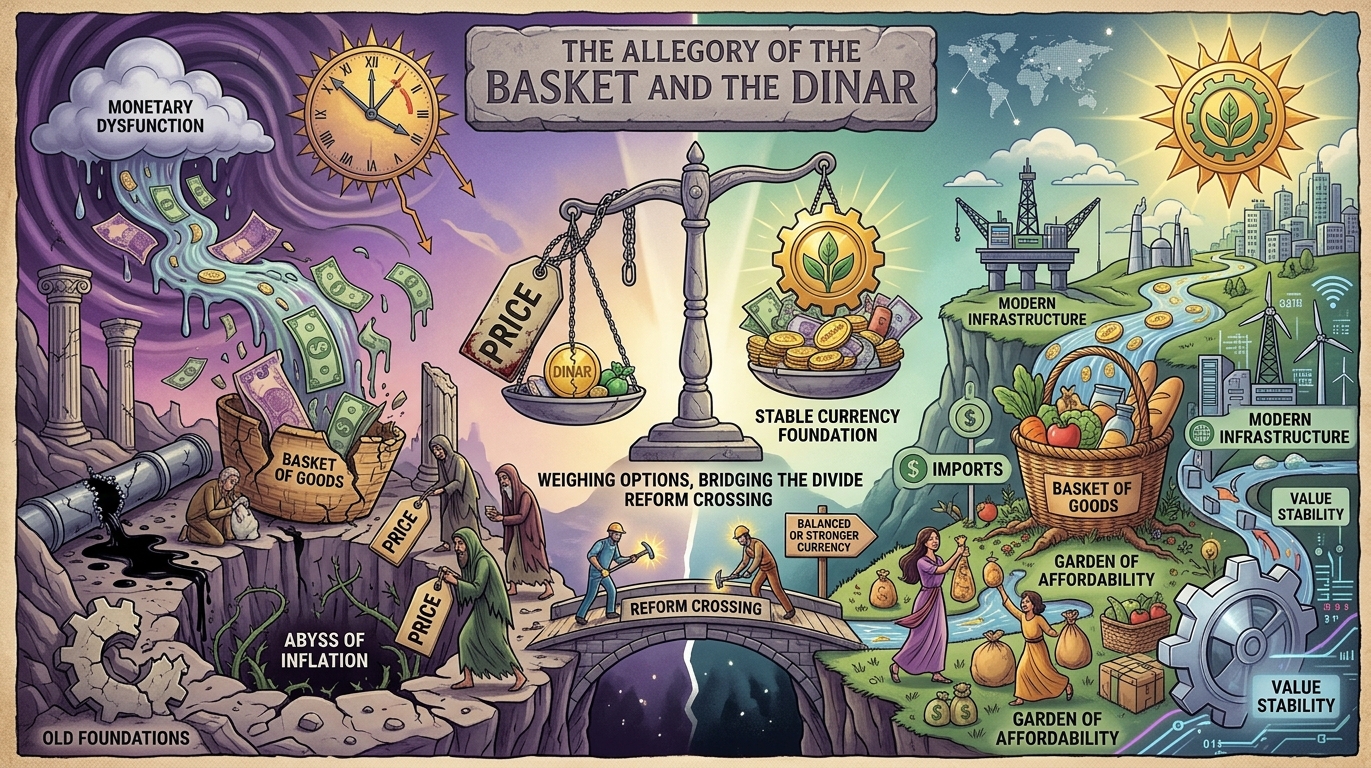
A Weaker Dinar, a More Expensive Basket: Who Protects Iraqi Households After the Dollar Exchange Rate Hike?
Analytical Article | Osoul Foundation for Economic Development and Sustainable Development
Weeks after Iraq raised the official dollar exchange rate from IQD 1,320 to IQD 1,520, the economic debate is no longer confined to monetary policy or foreign reserve management. Instead, it has shifted to a more pressing question: Who bears the cost of the exchange rate adjustment, and how can Iraqi households be protected from a wave of rising prices?
While the government has announced a package of measures to support various economic sectors, households are facing mounting pressure on their purchasing power amid continued reliance on imports and a widening gap between the official dollar exchange rate and the rate on the parallel market.
From the Exchange Rate to the Family Table
Iraqi households do not measure the impact of monetary policy by the figures announced in official statements, but by how much they pay for food, electricity, transport, housing, and medicine. The increase in the dollar exchange rate has quickly been reflected in the prices of several essential commodities, including sugar, rice, eggs, and cooking oil, according to local media reports.
These developments reveal a problem that goes beyond a simple exchange rate adjustment. The Iraqi economy relies heavily on imported goods, making it difficult to avoid the pass-through of exchange rate changes to domestic prices, particularly given limited local production and the lack of alternatives available to consumers.
According to economic monitoring, the dollar continued to trade above the official rate on the parallel market through late October, raising questions about the ability of monetary measures alone to narrow the gap and achieve the desired stability.
Khalid Al-Jabri: Social Protection Must Accompany Economic Adjustment
Engineer Khalid Al-Jabri, Chairman of the Osoul Foundation for Economic Development and Sustainable Development, believes that discussions about the exchange rate should not be separated from the cost of living and households’ ability to bear the resulting economic burdens.
In media statements, Al-Jabri noted that Iraqi households face substantial financial burdens in accessing essential services. He estimated the monthly cost of seven services—healthcare, education, electricity, roads, transport, internet, and drinking water—at approximately IQD 665,000, excluding food, housing, and clothing.
He also estimated that a five-member household needs at least IQD 1.5 million per month to cover its basic needs.
From this perspective, Al-Jabri argues for distinguishing between households unable to meet their basic needs, those facing mounting cost-of-living pressures, and those capable of absorbing economic changes. Under this approach, support policies should not be broad and untargeted; rather, they should be designed according to income levels and actual needs.
Among his key proposals is the introduction of dedicated support vouchers for food, electricity, and essential services, distributed to eligible households and redeemable through designated providers. This proposal could be developed into an electronic support card that links eligibility to income levels and directs public resources toward the groups most severely affected.
This approach is particularly important because an exchange rate adjustment, even when it forms part of a broader effort to address economic imbalances, does not in itself guarantee protection for low-income groups. The success of any monetary adjustment requires an assessment of its distributional effects, identification of the groups bearing its costs, and the design of measures to mitigate the resulting harm.
Bank Transfers and Confidence in the Financial System
The problem extends beyond prices. Al-Jabri pointed out that delays in international bank transfers, which according to his statements can extend to between 39 and 45 days, push some traders to seek dollars on the parallel market, potentially increasing pressure on the exchange rate.
This observation highlights an important aspect of monetary policy management: regulatory measures do not achieve their objectives simply by being introduced. Their effectiveness also depends on implementation efficiency, the speed of transaction processing, and market participants’ confidence in the banking system.
There is therefore a need to address bottlenecks that delay transfers, establish clear processing timeframes, and enhance transparency in banking procedures. The higher the cost of using official channels, or the longer the waiting period, the stronger the incentive to seek alternative channels—potentially undermining the effectiveness of monetary policy.
From Inflation Management to Building Domestic Production
Al-Jabri also stresses that inflation cannot be addressed indefinitely through monetary instruments alone, particularly in an economy that relies on imports and faces constraints on its productive capacity.
In this context, he has proposed several measures to encourage industrial investment. These include making land available for factories, simplifying industrial licensing procedures, linking tax obligations to businesses’ ability to generate profits, and applying customs tariffs selectively according to the nature of goods and domestic production priorities.
These proposals require careful design to balance consumer protection with industrial development, ensuring that customs duties do not become an additional source of higher living costs or increased production input costs. The objective is not to raise the cost of imports across the board, but to gradually expand domestic productive capacity and reduce dependence on foreign goods wherever genuine economic opportunities exist.
This debate is particularly relevant to the construction sector, which relies on imported materials and equipment for part of its operations. Al-Jabri has warned of increases in production, import, shipping, and insurance costs, estimating these increases at approximately 20–25%. If such increases materialize, their effects could extend to project costs, investment, and housing, broadening the impact of exchange rate changes beyond consumer goods markets.
Qutaiba Al-Zaki: Investors Need Certainty
From another perspective, stability in economic decision-making emerges as a fundamental element of the business environment.
During a discussion on the Numu economic podcast, Mr. Qutaiba Al-Zaki, a Senior Director at Deloitte Middle East, explained that investors do not necessarily seek a low tax rate as much as they seek “tax certainty.” This includes clear rules, consistent and predictable decisions, fairness, and transparent mechanisms for lodging objections.
Although Al-Zaki’s remarks focused on tax policy, the underlying principle has broader implications for economic management. Investors, traders, and consumers all need predictable rules, clear procedures, and an environment in which regulatory surprises do not add to existing commercial risks.
This principle becomes particularly important in the context of exchange rate changes when monetary adjustments coincide with rising import costs, volatility in the parallel market, and declining purchasing power. Stability does not mean freezing all prices or preventing change. Rather, it means clearly communicating economic policy objectives, announcing accompanying measures, and providing practical mechanisms to address their consequences.
What Needs to Be Done Now?
The indicators suggest that Iraq’s challenge is not simply to choose an appropriate exchange rate, but to manage its implications for society, production, and investment. This assessment can be translated into three practical policy priorities:
First: Protect the households most severely affected.
Explore the implementation of an electronic support card covering food, electricity, and essential services, based on clear and regularly updated eligibility criteria, while assessing its fiscal cost and the budget’s capacity to finance it.
Second: Improve the efficiency of banking channels.
Address delays in international transfers, establish and communicate clear processing timeframes, and strengthen confidence in the banking system to reduce reliance on the parallel market.
Third: Support domestic production.
Simplify industrial procedures, review customs duties and tariffs in light of their effects on consumers and producers, and direct incentives toward activities capable of creating jobs and reducing dependence on imports.
An exchange rate adjustment is an economic decision whose consequences extend far beyond monetary policy. Its success should therefore not be assessed solely by the dollar exchange rate or the level of foreign reserves. It must also be measured by its impact on household incomes, production costs, investor confidence, and the economy’s capacity to generate employment opportunities.
In this context, the Osoul Foundation for Economic Development and Sustainable Development monitors the effects of economic changes on households and the private sector. This work aims to provide a clearer picture of the scale and distribution of economic burdens across different social groups and governorates, while developing data-driven recommendations that support the broader economic reform process.