
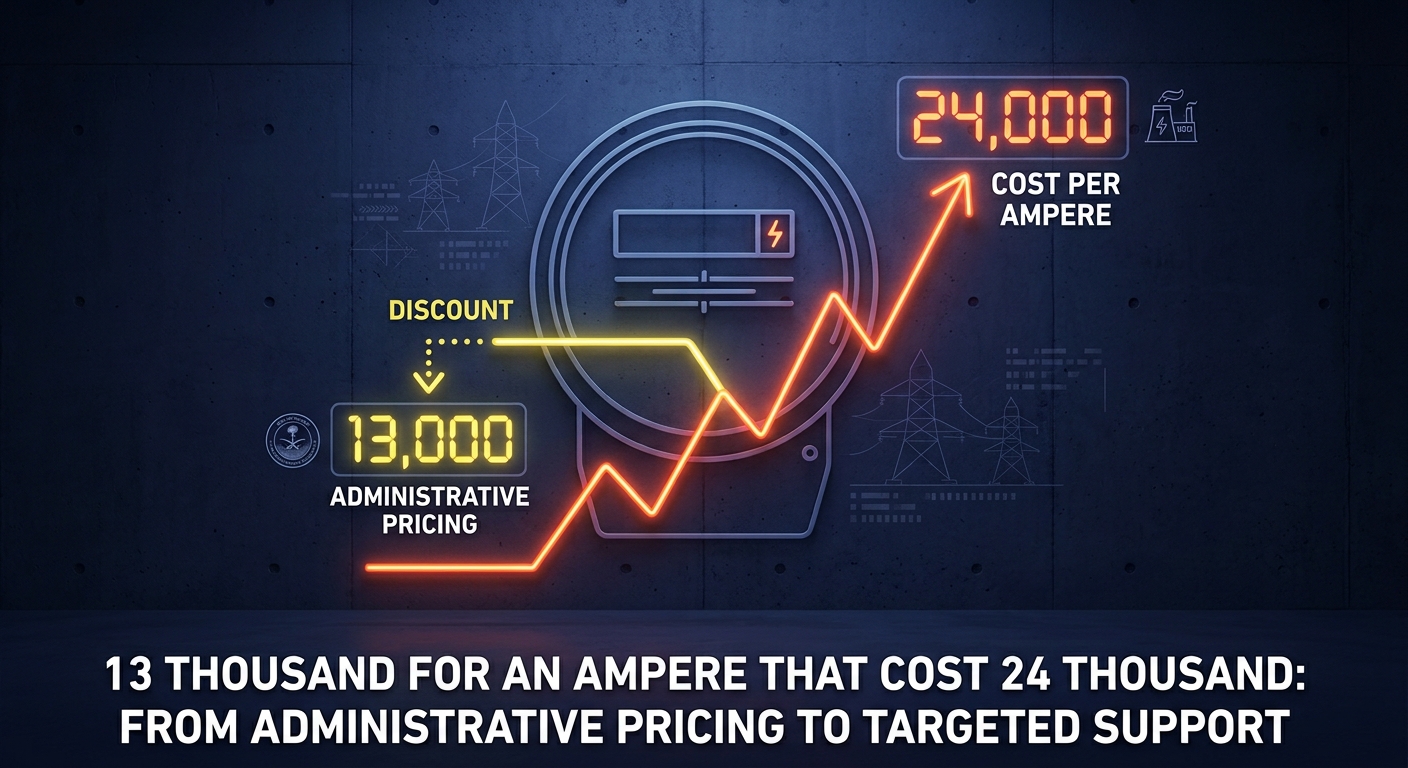
On 1 November 2026, the local administration in Kirkuk raised the monthly price of one ampere of neighbourhood-generator power from IQD 14,000 to IQD 18,000 (about $9.2 to $11.8 at the official rate of IQD 1,520 per dollar), an increase of roughly 29%. Within 48 hours, night protests broke out and the road to Erbil was blocked. The provincial council cut the price to IQD 13,000 (about $8.6) until the end of the month. Generator owners answered by switching off, saying an ampere really costs them IQD 24,000 (about $15.8).
The new administrative price therefore covers about 54% of the cost operators claim. Kirkuk is not alone. Baghdad set its November price at IQD 12,000 for round-the-clock “golden” service and IQD 8,000 for regular hours. On 3 November, Prime Minister Ali Falih al-Zaidi referred the generator-pricing file to the Integrity Commission and ordered more grid power and fuel for Kirkuk.
The central argument here is simple. The ampere price is not a number to be negotiated with the street; it is the result of fuel costs. The answer is targeted support for households, not a price cap that switches supply off.
Diagnosis: where the cost comes from
For readers outside Iraq: most Iraqi homes buy a fixed number of amperes from privately run neighbourhood diesel generators to cover the hours the national grid cannot supply. Three channels transmit shocks into that ampere price.
Fuel. Kirkuk’s generator owners receive about 20% of their needs as subsidised diesel and buy the rest. A barrel on the black market reached IQD 280,000 (about $184). In Baghdad, the allocation of 40 litres per kVA lasts only about a week of operation.
The grid. National generation stood at about 29 GW against an estimated summer 2026 peak demand of 40 GW. Iranian gas imports fell in May 2026 to about 5 million cubic metres a day, against 30 million at their peak. Every hour the grid misses is loaded onto the generators.
The exchange rate. Since 7 October 2026 the official rate has been IQD 1,520 per dollar, while the black-market rate was about IQD 1,682 on 3 November. Fuel bought outside the quota is implicitly priced in that market.
The outcome is distributional before it is technical. A middle-income family spends IQD 1.1–1.25 million a year on the two electricity bills combined, and the burden weighs relatively more on poorer households. When a price is imposed below cost, the subsidy shifts from the state to the generator owner. He cuts hours or switches off, and the subscriber ends up the loser.
| Price (November 2026) | IQD per ampere per month | Share of claimed cost |
| Cost claimed by Kirkuk generator owners | 24,000 | 100% |
| Kirkuk after the increase | 18,000 | 75% |
| Kirkuk provincial council decision | 13,000 | 54% |
| Baghdad “golden” service | 12,000 | 50% |
| Baghdad regular service | 8,000 | — (fewer hours) |
What the world says
The OECD’s experience of the 2022–2023 energy crisis is clear: untargeted measures accounted for 77% of the cost of energy support. The OECD recommends using existing social-assistance lists as a fast route to targeting, citing France’s energy voucher and Costa Rica’s monthly transfer to vulnerable households.
In an April 2026 note on the new energy shock, the OECD distilled three lessons: target vulnerable households, build in sunset dates, and preserve price signals so the incentive to save energy is not lost.
Pierre-Olivier Gourinchas, the IMF’s chief economist, wrote that any fiscal support “should be narrowly targeted and temporary”, and that direct transfers to vulnerable households typically give more relief than price caps and broad subsidies. The World Bank estimated in 2026 that only about 15% of subsidies in emerging economies reach low-income households.
Regionally, Lebanon is the closest case. Its energy ministry publishes a monthly per-kWh price for generator subscribers, linked to the diesel price, plus a fixed fee for each ampere package; the latest published tariff was about $0.54 per kWh. The price follows cost through a published formula, which takes much of the politics out of the number.
The fiscal context narrows the options. The IMF expects Iraq’s economy to contract by 16% in 2026 and is preparing programme discussions with Baghdad. Reserves fell from $102 billion in February to $78.3 billion in July 2026. A blanket subsidy on every litre of diesel is no longer affordable.
The consultancies’ reading
In its 2020 study of electricity pricing reform in the Gulf, Strategy& Middle East, part of the PwC network, estimated that electricity subsidies had cost GCC states more than $120 billion over two decades. It warned that “simply charging all users a higher tariff will not work”, arguing that tariffs should reflect the cost of serving each category, with transitional support for the weakest and phasing over several years.
The lesson for Iraq: the problem is not that support exists, but that it is aimed at the commodity rather than the household.
The Iraqi view: Al-Jabri and the global debate
Mr. Khaled Al-Jabri, President of the Osoul Foundation for Economic Development and Sustainable Development, stated that there is a “struggling” segment of society that must be supported regardless of the dollar rate, which he estimates at no less than 40% of households. He proposed an “electricity coupon”: the household receives a card it hands to the generator owner, and the state compensates the owner in diesel, alongside a food coupon with discounts at designated shops, for families earning less than IQD 1.5 million (about $987) a month.
The proposal converges with the OECD and Gourinchas on targeting, and adds an Iraqi answer to the delivery problem: support flows through the generator owner, who receives fuel instead of being forced into a loss-making price. Al-Jabri also sees direct support coming from lowering generator prices and subscriptions “through diesel quotas to the generators”, but considers indirect support, by cutting customs and tax values on basic goods, the more important lever.
Al-Jabri rejects treating the generator owner as an adversary; in his words, the owner “fills the electricity deficit for me”. What is needed is to organise these substitute sectors, not to milk them: organising them, he said, does not mean imposing a tax on them. He notes that citizens pay for electricity “twice”, that a household spends about IQD 665,000 (about $437) a month to compensate for seven failing public services, and that 83% of households suffer electricity deprivation in summer.
Al-Jabri adds a dimension missing from the pricing debate: “the problem with electricity is not distribution or production; it is the way we build.” With about 1.5 million air conditioners entering the country every year, generation will keep chasing consumption. He also warned that global increases of 20–25% in electricity prices and 10–15% in food prices will be transmitted as domestic inflation, because Iraq is an importing country.
Where does the proposal need calibration? The OECD warns against support that kills the price signal. A coupon preserves it if it is a fixed amount per household, not a cut in the ampere price for everyone.
From the field
As guest Saman Bojan, General Manager of Asiacell, said in the episode “كيف تحول قطاع الاتصالات في العراق” (How Iraq’s Telecom Sector Was Transformed) of the Seed | Nmw podcast, energy should be treated “as sovereign infrastructure, not a luxury”. He cited a nationwide blackout of about 24 hours during which telecoms stayed up, because operators generate their own power.
Recommendations
- Ministry of Electricity and provincial councils: a published monthly pricing formula for the ampere, linked to the official diesel price and operating hours, released on the first of each month.
- Ministry of Oil: tie subsidised fuel quotas to hours actually supplied, and bring unregistered generators into the quota system once counted.
- Ministry of Labour and Social Affairs and Ministry of Trade: a fixed-value electricity coupon for households below IQD 1.5 million, delivered through social-welfare lists and the ration card (Iraq’s public food-distribution card), redeemable by generator owners in diesel.
- Provincial councils: license generators and phase in meters, without new fees or taxes on the activity.
- Banks and the Development Fund: concessional loans for thermal insulation and rooftop solar, with instalments close to a generator subscription.
- Council of Ministers: a fixed term for any emergency fuel support, reviewed every six months.
Conclusion
Kirkuk shows that an administrative price below cost shifts the burden from the citizen to the generator owner, and then returns it to the citizen as darkness. The alternative is simple: support the household, not the commodity; regulate the generator, do not tax it; and build homes that do not need so much electricity.
Why Osoul?
The Osoul Foundation for Economic Development and Sustainable Development is an Iraqi institution that links data to economic decisions. It combines monitoring of the Iraqi street, measurement of household and business opinion, and comparison with the best international experience to produce implementable solutions.
- Daily monitoring and the weekly Iraq Economic Observatory: tracking what Iraqis discuss on the economy and services, and government decisions, in their regional and global context.
- Surveys and indices: the Business Outlook Survey, the Service Gap Burden Index, and regular surveys built on established international methodologies, including a new survey on generators and household electricity costs.
- Knowledge from the field: a documented library of economic positions, and the Seed | Nmw podcast, which interviews leaders of Iraqi companies.
- Workshops and policy briefs: workshops with research centres and stakeholders whose outputs become recommendations for decision-makers.
- Advisory and technical services for major companies and government agencies: data-driven studies, diagnostics and reform proposals, including concept papers on economic reform for decision-makers.
The Foundation’s work is available at www.ofesd.com and on its social media accounts.
Sources
- 964 — Kirkuk protests spread as generator owners strike over council’s fee cut (2026): https://en.964media.com/54631/
- 964 — Baghdad sets ampere price (Arabic, 2026): https://964media.com/732115/
- 964 — Al-Zaidi intervenes in Kirkuk (Arabic, 2026): https://964media.com/732658/
- Shafaq News — Two electricity bills strain Iraqi household budgets (2026): https://shafaq.com/en/society/Two-electricity-bills-strain-Iraqi-household-budgets
- Shafaq News — Iraq power 2026: war on Iran collapses the grid’s last defenses (2026): https://api.shafaq.com/en/Report/Iraq-power-2026-war-on-Iran-collapses-the-grid-s-last-defenses-ahead-of-peak-summer
- Shafaq News — Iraq raises official dollar rate to 1,520 IQD (2026): https://shafaq.com/en/Economy/Iraq-raises-official-dollar-rate-to-1-520-IQD
- Dollar prices in Iraq, 3 November 2026 (Arabic): https://www.ahmed-aldaoody.com/2026/11/2026113-100-21.html
- Shafaq News — IMF: Iraq’s economy to shrink 16% in 2026: https://shafaq.com/en/Economy/IMF-Iraq-s-economy-to-shrink-16-in-2026
- Iraq Business News — IMF to Launch Programme Discussions with Iraq (2026): https://www.iraq-businessnews.com/2026/11/02/imf-to-launch-programme-discussions-with-iraq/
- Mustaqila — World Bank expects 12.4% contraction (Arabic, 2026): https://mustaqila.com/%D8%A7%D9%84%D8%A8%D9%86%D9%83-%D8%A7%D9%84%D8%AF%D9%88%D9%84%D9%8A-%D9%8A%D8%B5%D8%AF%D9%85-%D8%A7%D9%84%D8%B9%D8%B1%D8%A7%D9%82-%D8%A8%D8%AA%D9%88%D9%82%D8%B9%D8%A7%D8%AA-%D8%AE%D8%B7%D9%8A%D8%B1/
- OECD — Restoring Public Finances (2026): https://doi.org/10.1787/fbcf9161-en
- OECD — Energy prices are spiking again: New relief measures, old lessons (2026)
- Pierre-Olivier Gourinchas, IMF Blog — War Darkens Global Economic Outlook and Reshapes Policy Priorities (2026): https://www.imf.org/en/Blogs/Articles/2026/04/14/war-darkens-global-economic-outlook-and-reshapes-policy-priorities
- World Bank — Hooked on Subsidies: The Case for Reform (2026)
- L’Orient Today — Generator rates in Lebanon at highest since April (2026): https://today.lorientlejour.com/article/1546224/generator-rates-in-lebanon-at-highest-since-april.html
- Strategy& Middle East (PwC) — Electricity pricing reform: A bitter pill for GCC industries (2020): https://www.strategyand.pwc.com/m1/en/reports/2020/electricity-pricing-reform/electricity-pricing-reform.pdf