
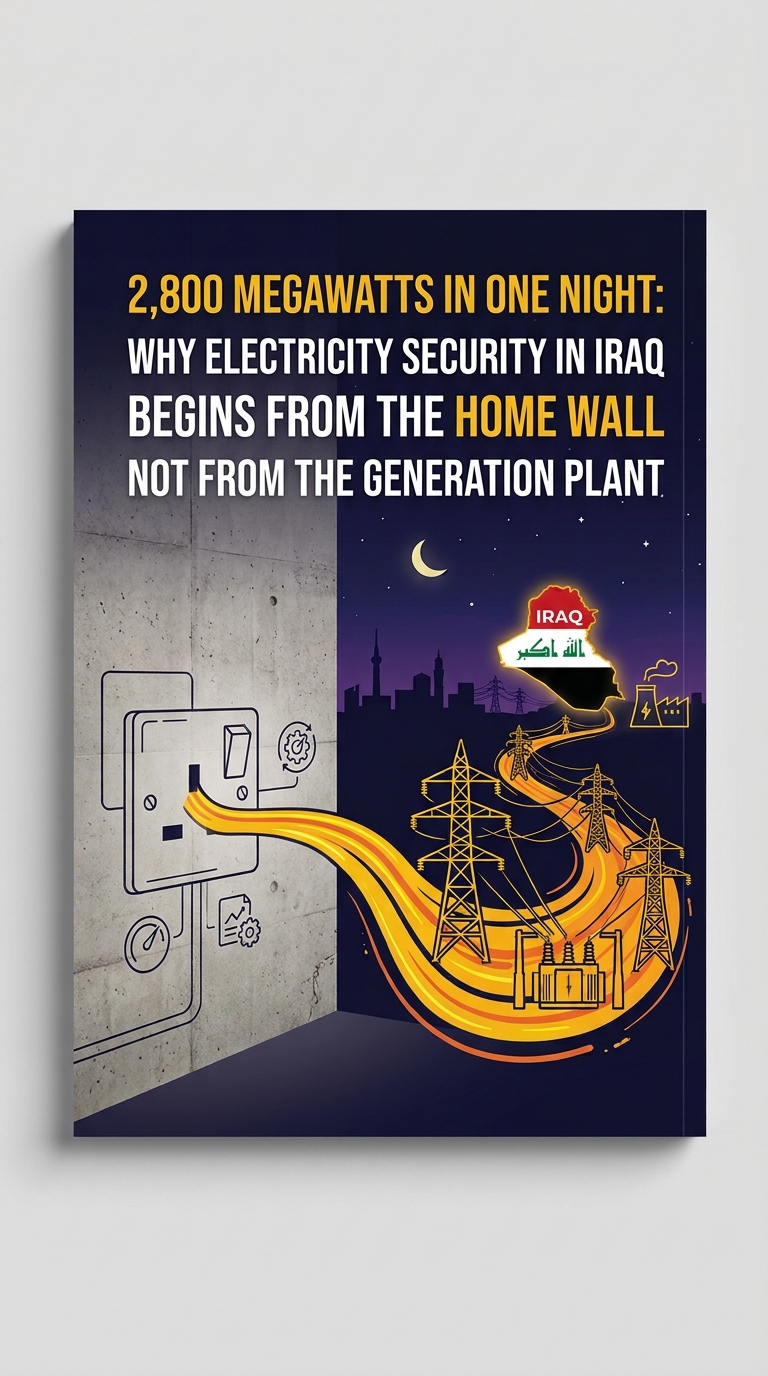
Introduction: a shock that exposes a structural weakness
On the night of 8 November 2026, a single drone halted the Khor Mor gas field. The Kurdistan Region lost between 2,500 and 2,800 megawatts, and gas stopped flowing to five power stations. Cities in the region went more than nine hours without grid power, and Erbil set fixed operating hours for private neighbourhood generators until the grid recovers.
The picture elsewhere in Iraq differs in degree, not in kind. Most Iraqi households buy backup power by the ampere from a neighbourhood generator owner. In Baghdad, the November price was set at IQD 12,000 per ampere for round-the-clock (“golden”) service and IQD 8,000 for standard service (about $7.90 and $5.30 at the official rate of IQD 1,520 per dollar). Yet the subsidised fuel quota covers roughly one week of generator operation. In summer the ampere reaches about IQD 20,000, so a household with five amperes pays around IQD 100,000 a month (about $66), on top of a state bill of roughly IQD 30,000.
The central argument of this article is that Iraq’s power crisis is not only a generation crisis. It is a crisis of unmanaged demand, unsecured fuel and a grid that loses what it carries. Without tackling demand, every new megawatt is a race Iraq cannot win.
Diagnosis: three channels of fragility
The first channel is fuel. In 2023 Iraq flared about 18 billion cubic metres of associated gas, enough in theory to generate some 33 gigawatts. That same year, maximum actual generation did not exceed 27 GW against peak demand near 45 GW. The International Energy Agency puts flaring at about 12 bcm in mid-2024, with only 65% of produced gas captured. The gap between the two estimates is methodological; the direction is the same. The fuel exists, and it is being burned.
The second channel is the grid. More than 40% of generated electricity is lost in transmission and distribution, and revenues cover no more than about 10% of costs. Every added megawatt therefore passes through a network that wastes close to half of it, financed from an already strained budget.
The third channel is demand, the least discussed in public debate. Iraqi homes are uninsulated, air conditioners run without pause, and the neighbourhood generator fills the gap at high cost to the household. Any shock — an attack on a field, a halt in imported gas, a heatwave — is therefore passed straight to the citizen through the ampere price and generator hours.
The shock coincides with fiscal pressure. The cabinet is discussing the 2027 budget today, with a deficit one member of parliament puts above IQD 43 trillion (about $28 billion). Electricity allocations may reach IQD 37 trillion (about $24 billion), according to remarks attributed to the deputy prime minister. Brent has slipped to about $91 a barrel, and SOMO widened the December discount on Basrah Medium to Asia to $8.80 below the Oman/Dubai average. Fiscal space no longer allows a repeat of the “more power plants” model without assured returns.
What the world says
The OECD, in its April 2026 brief on the new energy price shock, drew three lessons from the 2022–2023 crisis. Target vulnerable households and viable firms; set clear expiry dates for support; and preserve price signals so the incentive to save energy survives. Over the medium term, resilience comes from energy efficiency and diversified supply, and from the administrative capacity to deliver fast, targeted support.
Mariana Mazzucato, Professor in the Economics of Innovation and Public Value at University College London, argues that energy shocks have become “our new reality.” The right response, in her view, is not higher interest rates, which raise the cost of clean investment, but a mission-oriented industrial strategy led by the state. For Iraq, this means electricity is not the file of one ministry but a mission spanning construction, finance and industry.
The consultancies’ reading
McKinsey, in a 65-country analysis published in September 2026, concludes that a country’s response capacity — stockpiles, alternative suppliers and fuel substitution — matters more than its headline import dependence, and that “there is no single prescription for energy security.”
PwC, in its 2025 study of Middle East power value chains, warns that transformer lead times often exceed 24 months and can reach five years for large units. It recommends building grid infrastructure upfront in key zones. The lesson for Iraq is twofold: a new plant will not run for years, and the grid is its precondition, not an afterthought.
The Iraqi view: Al-Jabri and the global debate
Mr. Khaled Al-Jabri, President of the Osoul Foundation for Economic Development and Sustainable Development, stated that “the fault in electricity is not in distribution or production; the fault is in the way we build.” In his view, about 87% of Iraq’s energy is spent on buildings, and Iraq imports some one and a half million air-conditioning units a year, so generation is forever chasing consumption that grows annually. He compares Iraq with Canada, equally harsh in climate, where two to five hours of air conditioning suffice because homes retain heat.
Here Al-Jabri meets the OECD’s emphasis on efficiency, and adds an Iraqi specificity: efficiency starts with the building envelope. He estimates that 60–75% of a home’s consumption goes to cooling, heating and water heating, and that rooftop panels cannot run three or four split units. Leaks must therefore be sealed first, then insulation added. He proposes zero-interest loans for home insulation. He also holds that design which distributes spaces and daylight correctly can cut peak load by about 2,000 MW — capacity that would cost about $8 billion and two to three years to build.
On solar power, Al-Jabri argues that had the Central Bank of Iraq’s solar initiative been implemented over five years, it would have covered about 10% of output: 2,700 MW, worth some $2.7 billion, for roughly $700 million of spending. He calls for a grid-connection scheme under which citizens sell surplus power to the state. The idea echoes Mazzucato’s call for a state that steers the market toward a clear mission.
On the supply side, Al-Jabri stated that today’s crisis would not have happened had gas contracts been signed in 2010, 2015 or 2018. He sees the gas project with TotalEnergies as switching off both imported and flared gas, and pointed to the gas-storage gap and the floating platform meant to feed the system. That is the essence of what McKinsey calls response capacity.
He adds that electricity bill collection could reach IQD 4–6 trillion (about $2.6–3.9 billion), and that electronic payment in the sector has failed to deliver after three years and needs urgent review. Osoul Foundation indicators he presented show that 83% of families suffer electricity deprivation in summer.
From the field
As guest Ismail Marqa, Senior Partner at PwC Iraq, said in the episode “العراق غني بثرواته الطبيعيه والبشرية والتنمية تكون بجودة ادارتها!” (Iraq Is Rich in Natural and Human Resources, and Development Depends on the Quality of Their Management) of the Seed | Nmw podcast, an investor asks first about legislation, governance and how to protect the investment, because “capital is cowardly” and grows fearful without sufficient sovereign guarantees. Marqa sees the state as a regulator that leaves operations to the private sector. In a sector whose fields are targeted by drones, site security and sovereign guarantees become part of the cost of electricity itself.
Recommendations
- Cabinet and the electricity ministries in Baghdad and Erbil: a joint plan to protect critical energy sites, with a strategic gas reserve and alternative fuel for the region’s plants, and a public report on the findings of the Khor Mor investigation committee.
- Ministry of Finance and Parliament: tie electricity allocations in the 2027 budget to measurable indicators — lower losses and peak load, higher collection — not to added megawatts alone.
- Central Bank of Iraq and commercial banks: a zero-interest loan programme for thermal insulation and solar systems with binding technical standards, partly financed from fuel savings.
- Ministry of Electricity and the National Investment Commission: net-metering rules to buy surplus solar power from homes and businesses.
- Ministry of Construction and Housing, Baghdad Municipality and local municipalities: make insulation and daylight-distribution standards a condition of new building permits.
- Ministry of Oil: a published timetable for associated-gas capture, the floating platform and gas storage.
- Provincial councils: a generator fuel quota that covers the whole month, in exchange for meters, compliance with the official price and a public complaints mechanism.
Conclusion
The Khor Mor attack is not an isolated incident but a stress test, showing that Iraq’s power rests on a few points of failure. The world says resilience begins with efficiency and diversification; Al-Jabri says it begins at the wall of the house. Together, the two views offer Iraq a cheaper and faster path than a race to build plants: cut demand, secure fuel and fix the grid — at the same time.
Why Osoul?
The Osoul Foundation for Economic Development and Sustainable Development is an Iraqi institution that connects data to economic decisions. It combines monitoring of the Iraqi street, measurement of the views of households and firms, and comparison with leading international practice to produce actionable solutions.
- Daily monitoring and the weekly Iraq Economic Observatory: tracking what Iraqis discuss on the economy and public services, and government decisions, in their regional and global context.
- Surveys and indicators: the Business Outlook Survey, the Service Gap Burden Index, and periodic surveys built on established international survey methodologies.
- Knowledge from the field: a documented library of economic positions, and the Seed | Nmw podcast, which interviews leaders of Iraqi companies.
- Workshops and policy briefs: workshops with research centres and stakeholders, whose outcomes become recommendations for decision-makers.
- Advisory and technical services for major companies and government agencies: data-driven studies, diagnostics and reform proposals, including measuring household energy insecurity with established US survey methods.
- The Foundation’s outputs are available at www.ofesd.com and on its social media accounts.
Sources
- OECD — Energy prices are spiking again: New relief measures, old lessons, 2026
- Mariana Mazzucato — This energy shock demands a green industrial strategy (Project Syndicate via Arab News), 2026
- McKinsey — Energy security in an age of disruption, 2026
- PwC Middle East — From megawatts to ecosystems: Delivering resilient power value chains in the Middle East, 2025
- Baker Institute — Iraq’s Electricity Shortage and the Paradox of Gas Flaring, 2025
- Iraq Business News on the IEA Gas Market Report Q1-2025, 2025
- Kurdistan24 — Khor Mor attack cuts output by 2,800 MW (Arabic), 2026
- Al-Mada — Khor Mor targeted (Arabic), 2026
- Kalima — Erbil sets generator hours (Arabic), 2026
- 964 — Baghdad sets ampere price (Arabic), 2026
- Shafaq News — Two never-ending bills (Arabic), 2026
- Al-Mustaqilla — Iraqi press: decisive budget session (Arabic), 2026
- Attaqa — Iraqi crude price to Asia cut (Arabic), 2026
- Trading Economics — Brent crude, 2026