
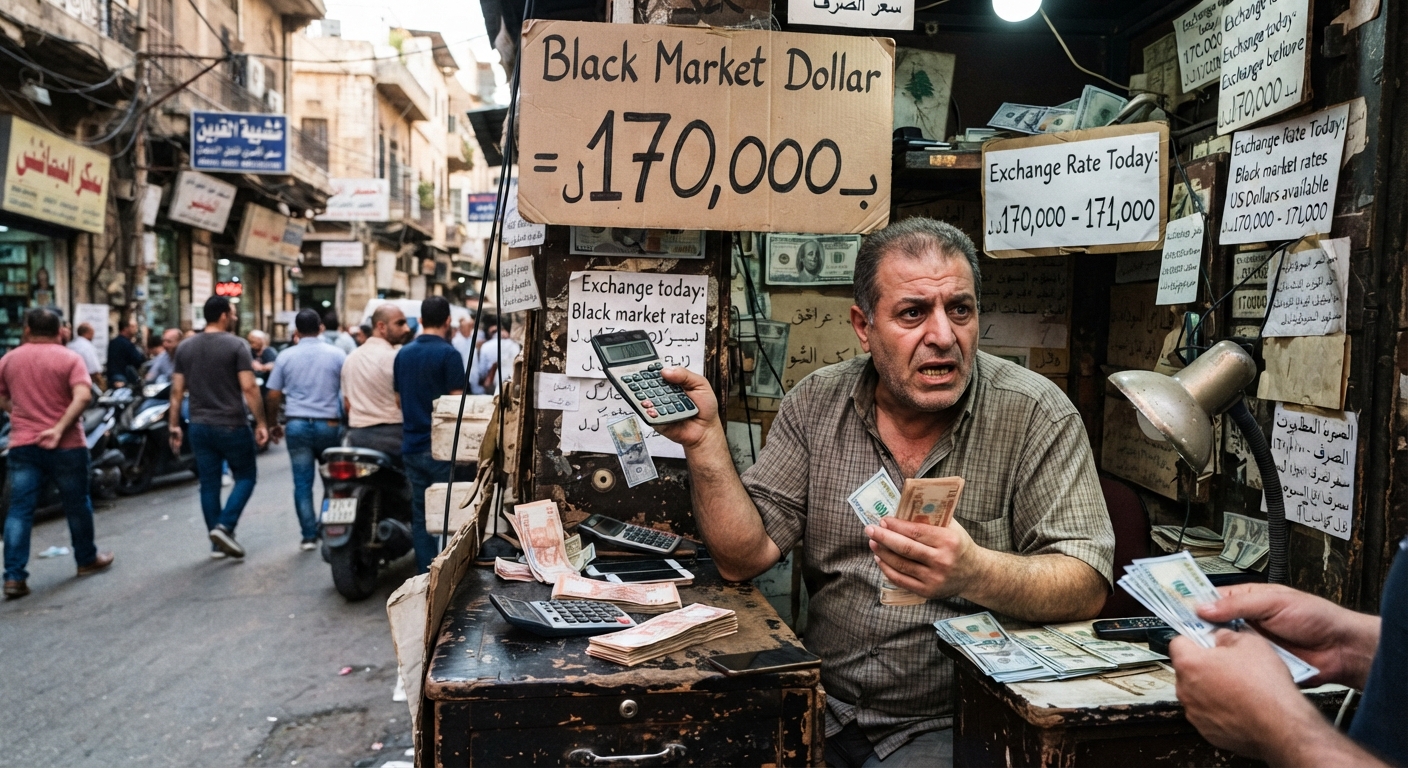
Iraq’s black-market dollar at IQD 170,000: the gap closes at the speed of a transfer, not by decree
Six weeks after Baghdad raised its official exchange rate, the gap between the official and black-market dollar is back at roughly 12%. A new price on paper has not closed it. Faster access to the official dollar would.
A number Iraqis read every morning
On 17 November 2026, Baghdad’s Kifah and Harthiya exchanges closed at IQD 170,350 per USD 100, or about IQD 1,704 per dollar. A day earlier the close was IQD 171,200, the highest in thirty days. The official rate, in force since 7 October, is IQD 1,520 per dollar. All dollar equivalents below use that official rate.
The gap is therefore about 12.1%. In late October the Central Bank governor had said it had narrowed to 9%, from 24%. Households do not see a percentage. They see dollar-denominated rents, instalments and imported goods, paid from salaries fixed in dinars.
Diagnosis: a problem of access, not of price
A black market exists when legitimate demand cannot reach the official dollar in time. In Iraq today, three channels squeeze that access at once.
The first is oil. The Strait of Hormuz remains nearly shut: 6.6 transits a day on a seven-day average, against 84.8 before the war. On 17 November Iraq sold Basrah Medium at USD 52.11 a barrel while Brent stood at USD 91.60, a discount of about USD 39.5. Every discounted dollar is a dollar that never reaches the treasury or the official foreign-exchange window.
The second is fiscal. The draft 2027 budget, built on IQD 1,500 to the dollar, exports of 4 million barrels a day and USD 85 oil, has still not been approved by the cabinet after repeated postponements. Spending runs month by month at one-twelfth of the previous allocation. Without a published budget, market participants price in the worst case.
The third is banking. A trader whose official transfer is held for weeks turns to the cash market. Partner customs data show that exports to Iraq from six major trading partners fell 29% in the first half of 2026, from USD 33.4 billion to USD 23.7 billion. When officially financed imports shrink while consumption continues, part of the financing migrates to cash outside the banks.
| Indicator | Value |
| Official rate (since 7 Oct 2026) | IQD 1,520 per USD |
| Baghdad black-market close (17 Nov 2026) | IQD 1,703.5 per USD |
| Gap | about 12.1% |
| Basrah Medium discount to Brent (17 Nov) | about USD 39.5 a barrel |
| Hormuz transits (7-day average) | 6.6 a day vs 84.8 pre-war |
| Official annual inflation (August 2026) | 3.3% |
What the world says
Experience with exchange-rate unification is clear. A 2021 IMF working paper by Simon Gray finds that when the gap is large and persistent, domestic prices tend to follow the black-market rate. It also concludes that a unified rate will not stabilise without a supportive fiscal and monetary context. For Iraq, the new official rate is a first step, not a solution.
The economist Carmen Reinhart warned years ago that many developing countries still lacked dollars despite freer exchange-rate regimes, and that in some the only thriving foreign-exchange market was the black market. Flexibility in the price does not guarantee availability of the currency.
In its September 2026 interim outlook, the OECD projected global growth of 2.9% in 2026. It noted that energy prices had risen again as disruption to Gulf production and exports intensified, with G20 inflation at 4.1%. Iraq imports most of what it consumes, so this inflation arrives through goods, and the gap then amplifies it.
On who bears the cost, the World Bank’s 2026 report on subsidies argues that broad exemptions benefit wealthier households more and miss poor families who buy in informal markets. It sees direct cash transfers as a more effective alternative. The OECD’s 2026 report The People and the Budget adds that trust weakens when citizens do not understand why reform is needed and how its costs and benefits are shared.
The consultancy view
PwC Middle East’s May 2026 Economy Watch placed Iraq among the economies most exposed to the Hormuz shock, given its reliance on the corridor for most of its hydrocarbon exports. It estimated that April output in the countries bordering the strait was about 10 million barrels a day below February, a fall of roughly 40%. It noted the option of extending the Kirkuk–Ceyhan pipeline south to Basra, while treating new pipelines as slow and costly.
Among its advice to companies: stress-test cash flows and review credit lines. That advice explains the Iraqi trader’s behaviour. When a transfer is delayed, he protects his liquidity in the black market.
The Iraqi view: what Al-Jabri adds
In the view of Mr. Khaled Al-Jabri, President of the Osoul Foundation for Economic Development and Sustainable Development, the dinar has no fixed “correct” value. A weaker currency helps a country that sells products for hard currency; a rentier state, he argues, has an interest in supporting its currency so as not to hurt society. This matches the IMF conclusion: a price alone does not hold without a real base behind it.
Al-Jabri stated that narrowing the gap starts with making transfers “very fast, not delayed in the banks”, giving everyone access to finance through banks, and speeding up customs and tax procedures, including tax clearance certificates. Otherwise, he warned, “the black market will grow”. He describes the mechanism through a trader whose transfer is held for two months: he pays his workers from his own pocket, then buys dollars in the market, “and this will push the dollar up”.
Here Al-Jabri adds something the general literature does not: the time a transfer takes is itself a monetary variable. He links it to banking security, arguing that any incident at a bank should be resolved “in less than an hour”, because trust is earned through experience.
On distribution, Al-Jabri holds that a vulnerable class must be supported “regardless of the dollar price”. Direct support would come through food coupons and kerosene quotas for neighbourhood generators (the private diesel generators that fill Iraq’s grid gaps) to cut subscription fees. Indirect support, which he sees as the most important, means providing seven basic services: health, education, drinking water, municipal services, roads, telecoms and electricity, plus food. In a preliminary estimate, he put a family’s monthly out-of-pocket spending on these services at about IQD 665,000 (around USD 438).
This converges with the World Bank’s preference for targeting over broad subsidies. It adds an Iraqi specificity: out-of-pocket spending on missing public services is an undeclared tax that grows heavier as the gap widens. On supply, Al-Jabri argued that the Ceyhan line “exports without a discount” and called for its rapid restart. Pumping resumed on 17 November at 120,000 barrels a day, with a stated target of 500,000.
From the field
As guest Ahmed Tahseen Mualla, Chief Executive Officer of Bank of Baghdad, said in the episode “دور المصارف في إعادة بناء الاقتصاد العراقي” (The role of banks in rebuilding the Iraqi economy) of the Seed | Nmw podcast, a banking model built on selling foreign currency was unsustainable. Many banks active on the transfer and FX platforms focused on them alone “because that was the lion’s share of their income”. He added that his bank had shifted towards financial inclusion and lending to individuals, corporates and SMEs.
The implication for the gap is direct. A bank that finances activity creates orderly demand for dollars. A bank that sells currency creates queues around the window.
Recommendations
- Central Bank of Iraq: a binding service standard for the execution time of official trade transfers, with weekly publication of each bank’s performance and penalties for unjustified delays.
- Council of Ministers: approve the 2027 budget on realistic export and price assumptions, because fiscal uncertainty feeds expectations.
- Ministries of Finance and Planning: a published and costed protection package for vulnerable and squeezed households, using food coupons and generator kerosene quotas, with a statement of who pays and who benefits.
- Ministry of Oil and SOMO: a public timetable for raising Ceyhan flows to 500,000 barrels a day, and monthly export data by outlet to curb rumours.
- General Commission of Customs and General Commission for Taxes: an electronic tax clearance certificate with a fixed maximum turnaround, since delays there delay the transfer.
- Private banks: shift part of their transfer business into trade finance and credit for SMEs.
Conclusion
Today’s gap is not a referendum on the official rate. It is a verdict on how long it takes to reach it. When a trader gets his official dollars in days, and a vulnerable family knows what protects it, the black market loses both its customers and its rationale.
Why Osoul?
The Osoul Foundation for Economic Development and Sustainable Development is an Iraqi institution that links data to economic decisions. It combines monitoring of the Iraqi street, measurement of household and business opinion, and comparison with the best international practice to produce actionable solutions.
- Daily monitoring and the weekly Iraq Economic Observatory: tracking what Iraqis discuss on the economy and services, and government decisions, set against the regional and global context.
- Surveys and indices: the Business Outlook Survey, the Service Gap Burden Index, and periodic surveys built on established international survey methodologies.
- Knowledge from the field: a documented library of economic positions, and the Seed | Nmw podcast, which interviews leaders of Iraqi companies.
- Workshops and policy briefs: workshops with research centres and stakeholders whose outputs become recommendations for decision-makers.
- Advisory and technical services for major companies and government agencies: data-based studies, diagnostics and reform proposals, including measuring the effect of the exchange rate on households and firms through its periodic surveys.
- Osoul’s work is available at www.ofesd.com and on its social media accounts.
Sources
- Alsumaria, “Dollar prices dip slightly at close in Baghdad and Erbil” (Arabic), 17 November 2026 — link
- IraqSM, “Dollar price at the Kifah exchange” (Arabic), 2026 — link
- Baghdad Today, “Dollar keeps rising in Baghdad, hits IQD 172,000” (Arabic), 16 November 2026 — link
- Al Jazeera Net, “First change in three years: Iraq raises official dollar rate to IQD 1,520” (Arabic), 7 October 2026 — link
- Kalima, “Basrah Heavy and Medium prices fall” (Arabic), 17 November 2026 — link
- now, “Strait of Hormuz live transit count”, 17 November 2026 — link
- The National, “Iraq resumes pumping crude oil for export through pipeline to Turkey”, 17 November 2026 — link
- Kitabat, “Iraqi government again postpones vote on 2027 budget” (Arabic), 10 November 2026 — link
- Shafaq News, “Exports to Iraq from six major partners fall 29%”, 1 November 2026 — link
- Simon T. Gray, “Recognizing Reality: Unification of Official and Parallel Market Exchange Rates”, IMF Working Paper 2021/025, 2021 — link
- Carmen Reinhart, “The Return of Dollar Shortages”, Project Syndicate, 2016 — link
- OECD, Economic Outlook, Interim Report September 2026: Weathering Successive Shocks, 2026 — DOI
- OECD, The People and the Budget: Empowering Public Understanding of Public Finances, 2026 — DOI
- World Bank, Hooked on Subsidies: The Case for Reform, 2026
- PwC Middle East, Middle East Economy Watch, May 2026 — link