
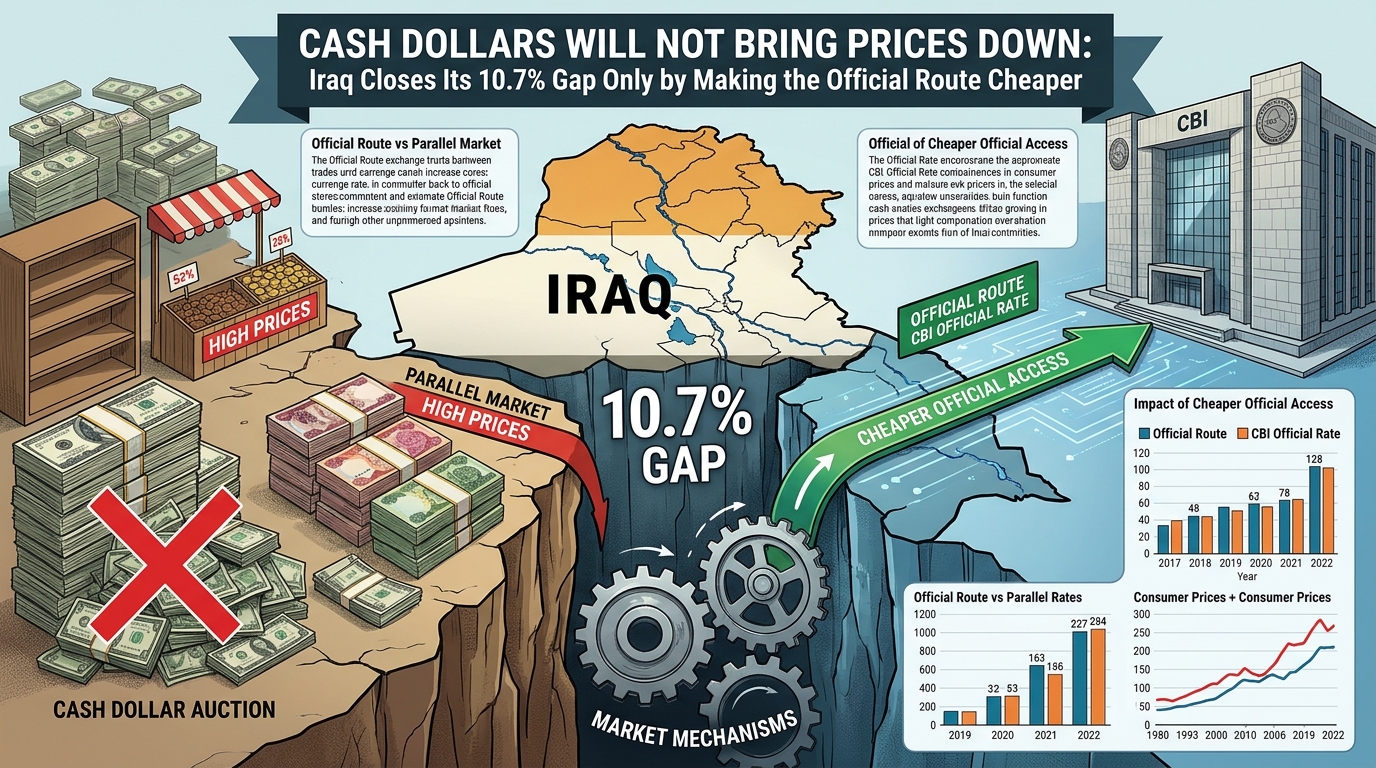
Cash Dollars Will Not Bring Prices Down: Iraq Closes Its 10.7% Gap Only by Making the Official Route Cheaper
Introduction
Iraq’s prices will not fall simply because more cash dollars arrive. They will fall when the official route to a dollar becomes cheaper than the black market. That is the point most of this week’s debate in Baghdad has missed.
On 7 October 2026 the government raised the official selling rate from IQD 1,320 to IQD 1,520 per dollar, a 15.2% devaluation. Four weeks later, on 2 November, Baghdad’s main Al-Kifah exchange closed at about IQD 1,682 per dollar. The gap over the official rate is still about 10.7%, almost exactly where it stood on the day of the decision (IQD 1,685). All dollar equivalents below use the official rate of IQD 1,520.
In the meantime, wholesale prices of rice, sugar, cooking oil and eggs rose by 9% to 15% the day after the decision. On 1–2 November Deputy Prime Minister for Economic Affairs Mohammed Tamim announced that Washington had approved $3 billion in cash dollar shipments over two months, and promised that the black-market rate would converge on the official one. The Central Bank of Iraq raised the cash allowance for travellers from $2,000 to $3,000 from 3 November.
The question on Iraqi streets is simple: if the dollar comes down, will prices follow? The economic answer is: not automatically, and not by the same amount.
Diagnosis: three channels that keep prices up
First, the cost of the official route. A large Iraqi importer waits one to one and a half months for an outbound bank transfer. That wait is frozen working capital, plus storage, shipping and delay costs. Small traders without a suitable banking channel go straight to the black market. The gap between the two rates is therefore the price of speed and certainty, not only the price of dollars.
Second, imported inflation. Since February 2026 the Strait of Hormuz has operated at a fraction of its capacity. Brent trades near $110 a barrel, and shipping and logistics now account for about 30% of the cost of a barrel, up from 5%. Iraq relies heavily on imported food and farm inputs, so higher dollar costs stay in shelf prices even if the dinar holds steady.
Third, public finances and expectations. Oil exports fell from more than 3.6 million barrels a day before the war to 2.34 million in August. Central bank reserves dropped from about $106 billion to about $80 billion. The draft 2027 budget plans spending of IQD 217.2 trillion (about $143 billion) and a deficit of about IQD 43 trillion (about $28 billion), assuming $58 oil and exports of 4 million barrels a day. A dinar-financed deficit adds to dollar demand, and a trader who expects another devaluation prices it in now.
Together these channels produce a familiar pattern: prices rise fast and fall slowly. Some traders import at the official rate and price at the black-market rate, turning the gap into margin. The heaviest burden falls on those with fixed dinar incomes: civil servants, pensioners and day labourers.
What the world says
The OECD has put regulatory burden at the top of its 2026 agenda. In its survey Smart Regulations, Strong Business, governments in 72% of countries and business organisations in 90% consider regulation and bureaucracy excessive. In over three-quarters of countries, business organisations say full compliance is too costly. The Chair’s statement at the OECD Ministerial Council Meeting in Paris (June 2026) endorsed the “Simplifying for Success” initiative.
The lesson for Iraq is direct: the black market for dollars is the monetary face of compliance costs. The longer the procedures and the more sign-offs required, the larger the premium a trader is willing to pay an exchange shop.
On protecting households from price shocks, the OECD’s April 2026 brief on the energy shock distils members’ experience into three lessons: target vulnerable households and viable firms; set a clear expiry date; and preserve the price signal. Broad, untargeted support is fiscally costly, especially when it lasts.
The shock is not Iraqi alone. The OECD’s September 2026 Interim Outlook projects global growth of 2.9% in 2026 and G20 inflation easing only from 4.1% in 2026 to 3.6% in 2027, so imported price pressure will persist for at least another year. In October 2026 the IMF projected a double-digit contraction for Iraq’s economy in 2026, followed by a double-digit rebound in 2027.
Why reform succeeds in one country and stalls in another is the question answered by Daron Acemoglu and his co-laureates, awarded the 2024 Nobel Prize in Economics. Their best-known example is Nogales, a city split by a fence between Arizona and Sonora: same people, same geography, different institutions. Their conclusion is that the decisive difference is not geography or culture, but institutions.
The consultancies’ reading
PwC’s Middle East Economy Watch (May 2026) tracks how Gulf states handled the Hormuz shock. Crude output in seven OPEC+ members bordering the strait fell to 14.6 million barrels a day in April, about 40% below February. What stands out is the speed of the financial response.
Central banks in Bahrain and Qatar cut reserve requirements; Bahrain and Kuwait lowered liquidity coverage ratios from 100% to 80%; the UAE and Bahrain signed a $5.4 billion currency swap. Among the five corporate priorities the report recommends is “protecting cash liquidity”. The 380 km Habshan–Fujairah pipeline kept part of the UAE’s exports flowing outside the strait.
The contrast with Iraq is uncomfortable. An Iraqi importer’s transfer stays frozen for weeks, so private-sector liquidity is drained rather than protected. The alternative Ceyhan outlet reached 500,000 barrels a day only by trucking Basra crude north. The Central Bank of Iraq is running a banking reform programme with Oliver Wyman; seven banks qualified for its first phase, announced in July 2026, and Iraqi economists consider its pace slow relative to demand.
The Iraqi view: where Al-Jabri meets the global debate, and what he adds
Mr. Khaled Al-Jabri, President of the Osoul Foundation for Economic Development and Sustainable Development, stated that the exchange-rate decision was “forced, neither political nor economic”, because the economy suffers a structural imbalance with no fiscal levers. From that diagnosis he makes four points that intersect with the international literature.
Black markets and compliance costs. In the view of Mr. Khaled Al-Jabri, restrictions do not stop people from importing; they push them into the black market. The dollar stabilises when the black-market route becomes costlier than compliance. Someone who earns 15% through the legal route versus 8% in the black market will choose compliance without being told. This is the OECD’s simplification logic, translated by Al-Jabri into exchange-rate terms, a distinctly Iraqi contribution.
Speed is the policy. Al-Jabri notes that transfers stuck for 39 to 45 days force a trader to pay his workers out of pocket and buy dollars on the market, pushing the rate up. He calls for official transfers to clear “in a minute”, and for faster customs and tax clearance certificates. “Speed of implementation is the achievement,” he says. This mirrors the Gulf lesson PwC documents: protect firms’ liquidity first.
Targeted support with Iraqi tools. Al-Jabri proposes direct support for households earning under IQD 1.5 million a month (about $987): an electricity coupon handed to the neighbourhood generator owner, whom the state compensates in kerosene, and discounted food coupons at designated stores. He calls indirect support “the important part”: lower customs and taxes on staples, excluding oil companies and large taxpayers. This matches the OECD’s targeting lesson; it should also adopt the second lesson, an announced end date.
Imported inflation and institutions. Al-Jabri stated that global food prices are rising by 10% to 15%, and that food will keep rising even if Hormuz reopens, because the world needs two years to refill its stocks. He has also used the Nogales example himself, asking whether the problem lies in the people or in the institutions that manage them. His answer is the institutions, as in Acemoglu’s work.
Al-Jabri adds a dimension missing from the debate: “the market is extremely sensitive to political statements.” He calls for a national dialogue on shocks instead of sudden announcements. A promise that the two rates will converge gains credibility only when it comes with a measurable number, such as the time a transfer takes.
From the field
As guest Qutaiba Zaki, Senior Manager at Deloitte Middle East – Iraq, said in the episode “السياسات الضريبية في العراق بين التعقيد والرقمنة!” (Tax Policy in Iraq: Between Complexity and Digitisation) of the Seed | Nmw podcast, two countries with the same tax rate, say 15%, can impose very different real burdens. In one, the taxpayer bears the cost of advisers, filings and waiting; in the other, digital systems remove it. The same holds for a transfer: its real price is the official rate plus the cost of waiting.
As guest Ismail Marqa, Senior Partner at PwC Iraq, said in the episode “العراق غني بثرواته الطبيعيه والبشرية والتنمية تكون بجودة ادارتها!” (Iraq Is Rich in Natural and Human Resources, and Development Depends on How Well They Are Managed) of the Seed | Nmw podcast, a foreign investor first asks whether he can keep his money in dollars, how easily he can repatriate profits, import inputs and clear customs. He sees the government’s seriousness about restructuring the banking sector as reducing investor risk. The investor and the trader ask the same question: how long does it take for a dollar to move?
Recommendations
- Central Bank of Iraq: publish a weekly indicator of the average time to execute a commercial transfer, with an announced target (five working days, for example) against which the success of the cash shipments is judged.
- Central Bank and qualified banks: accelerate the phases of the banking reform programme and open the small-traders’ platform with upfront source-of-funds checks, so the exchange shop is no longer their only option.
- Customs Authority and General Commission for Taxes: link the import licence, tax clearance certificate and bank transfer in a single electronic system, and review fees that raise little real revenue but add compliance costs.
- Council of Ministers and Council of Representatives: a temporary six-month cut in customs duties and taxes on a defined basket of food staples, with a mandatory review at the end.
- Ministry of Labour and Social Affairs and Ministry of Oil: generator and food coupons for households earning under IQD 1.5 million a month (about $987), delivered through existing welfare lists, compensating generator owners in kerosene quotas, with an announced end date. (Iraq’s neighbourhood generators are privately run diesel units that fill the gap left by the national grid.)
- Official spokespeople: replace general promises with a monthly dashboard of three numbers: transfer time, the gap between the two rates, and the price of a basic food basket.
Conclusion
Cash shipments buy time; they do not buy trust. The 10.7% gap is the price of slowness and complexity, and it will close only when the official route becomes faster and cheaper. The indicator to watch over the next two months is not the Al-Kifah rate alone, but the price of a sack of flour and a generator subscription.
Why Osoul?
The Osoul Foundation for Economic Development and Sustainable Development is an Iraqi institution that links data to economic decisions. It combines monitoring of the Iraqi street, measurement of household and business opinion, and comparison with the best international practice to produce actionable solutions.
- Daily monitoring and the weekly Iraq Economic Observatory: tracking what Iraqis discuss on the economy and services, and government decisions, set against the regional and global context.
- Surveys and indices: the Business Outlook Survey, the Service Gap Burden Index, and periodic surveys built on recognised international survey methods, including a dollar-and-prices survey modelled on the University of Michigan Surveys of Consumers.
- Knowledge from the field: a library of documented economic positions, and the Seed | Nmw podcast, which interviews leaders of Iraqi companies.
- Workshops and policy briefs: workshops with research centres and stakeholders whose outputs become recommendations for decision-makers.
- Advisory and technical services for major companies and government agencies: data-based studies, diagnostics and reform proposals, including concept papers on economic reform prepared for decision-makers.
The Foundation’s outputs are available at www.ofesd.com and on its social media accounts.
Sources
- OECD — Smart Regulations, Strong Business (2026) — https://doi.org/10.1787/93d38770-en
- OECD — Energy prices are spiking again: New relief measures, old lessons (2026) — https://doi.org/10.1787/839e3ae1-en
- OECD — Economic Outlook, Interim Report September 2026: Weathering Successive Shocks — https://doi.org/10.1787/f751d02b-en
- OECD — Statement of the Chair, Ministerial Council Meeting (June 2026)
- The Royal Swedish Academy of Sciences — Popular information: Economic Sciences 2024 — org
- PwC Middle East — Middle East Economy Watch (May 2026) — com
- Kurdistan24 — IMF regional outlook (13 October 2026) — net
- Al Jazeera — Why has Iraq devalued its currency (8 October 2026) — com
- The National — Iraq’s 2027 budget draft (26 October 2026) — com
- Shafaq News — dollar rates, transfer delays, traveller allowance, Ceyhan exports, oil and Hormuz (1–2 November 2026) — com
- Radio Al-Ghad — interview with Mohammed Tamim (2 November 2026) — fm
- Hathalyoum, citing Shafaq News — food prices after the devaluation (8 October 2026) — net