
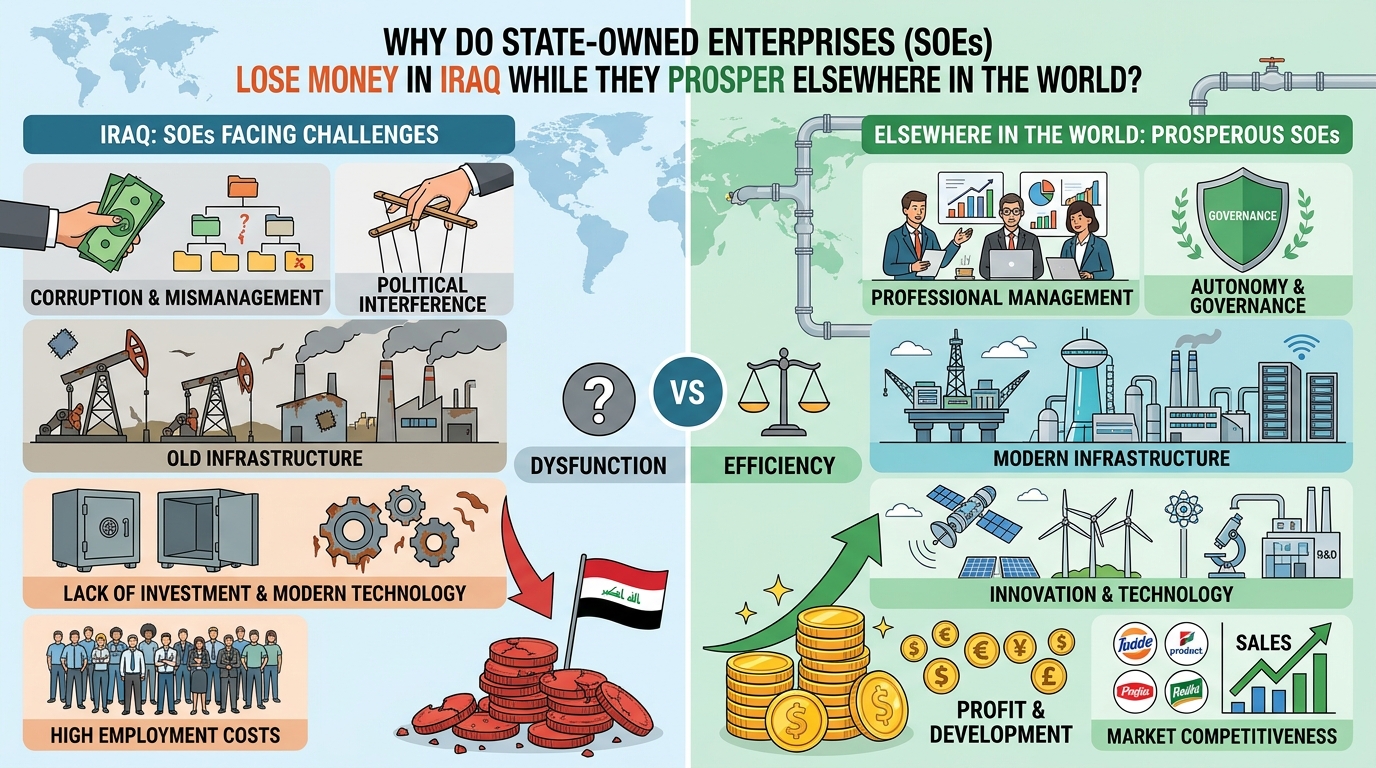
Why Do State-Owned Enterprises Lose Money in Iraq While They Prosper Elsewhere in the World?
October 29, 2026 | @Khalid
The Paradox: Vast Assets Worldwide, Chronic Losses in Iraq
Public ownership is not the cause of losses; the problem lies in how the state manages what it owns. This is the conclusion that emerges when Iraq’s experience is examined alongside the latest reports from the Organisation for Economic Co-operation and Development (OECD).
In October 2026, the OECD published its report, Ownership and Governance of State-Owned Enterprises 2026, together with its first analysis of a new global database. The database covers 33,800 state-owned enterprises (SOEs), with total assets of USD 141 trillion and a workforce of 43 million people in 2024.
By contrast, in 2021, Iraq’s Prime Minister’s financial adviser revealed that 72% of 173 public companies were operating at a loss. He stated that approximately 400,000 employees had been receiving salaries without performing productive work since 2003. Government-guaranteed bank loans to finance these companies, including interest, amounted to approximately IQD 16 trillion (Al-Ain News).
Even profitable state-owned enterprises are failing to remit their profits to the Treasury. In July 2026, a report by Iraq’s Federal Board of Supreme Audit revealed that public companies had failed to pay the Treasury its share of their profits. These included Basra Oil Company, which owed approximately IQD 2 trillion, and South Refineries Company, which owed around IQD 1.4 trillion (AGBI).
Why, then, are state-owned enterprises a source of wealth in some countries but a burden on the public budget in Iraq?
What the World Says: Good Ownership Matters More Than Ownership Itself
The OECD’s 2026 report examines ownership arrangements, disclosure practices, board structures, and anti-corruption measures across 58 economies (OECD). The benchmark used to assess these practices is the OECD Guidelines on Corporate Governance of State-Owned Enterprises, revised by the organisation in May 2024.
These guidelines establish five conditions that distinguish successful state-owned enterprises from loss-making ones (OECD Guidelines):
- A clearly stated rationale for ownership: The state must explain why it owns each enterprise and periodically review the justification.
- A single ownership entity, separate from regulation: The entity responsible for ownership should not set market rules or determine sectoral policy.
- A level playing field: State-owned enterprises should not be exempt from laws or taxes. They should obtain financing on market terms and generate commercial returns. Any public service obligations imposed by the state should be financed separately and disclosed transparently.
- Merit-based boards of directors: Boards should include independent members, operate without political interference in day-to-day activities, and have the authority to appoint and dismiss the chief executive.
- Disclosure standards comparable to those of listed companies: These should include an annual independent external audit and a consolidated annual report covering the state-owned enterprise portfolio.
In our region specifically, the OECD estimated that state-owned enterprises account for approximately half of economic activity in the Middle East and North Africa. It also observed that Gulf sovereign wealth funds have improved the governance of these enterprises because they operate separately from government ministries and are less exposed to political decision-making (Gulf News).
Economists Dag Detter and Stefan Fölster, authors of The Public Wealth of Nations, reach the same conclusion. In a blog post published by the International Monetary Fund (IMF), they described the debate over privatisation versus nationalisation as a false war that had persisted for a quarter of a century. What makes the difference, they argued, is the quality of asset management, not the identity of the owner (IMF PFM Blog).
More broadly, the 2024 Nobel Prize in Economic Sciences was awarded to Daron Acemoglu, Simon Johnson, and James A. Robinson for their research on the role of institutions. Their central finding is that societies with weak rule of law and extractive institutions fail to achieve sustained growth (News24).
State-owned enterprises provide one of the clearest tests of this proposition: the same asset can generate profits or losses depending on the institutions responsible for managing it.
Malaysia provides a practical example. Following a state-owned enterprise reform programme launched in 2004, the market value of these enterprises tripled by 2014. Their return on equity approached the levels achieved by listed companies. The programme relied on publicly disclosed financial performance indicators, management drawn from both the public and private sectors, and an academy established to train board members (World Bank).
Consulting Firms’ Perspective: Conflicting Objectives and Political Interference
Research by major consulting firms supports the OECD’s diagnosis while offering additional tools for implementation.
McKinsey found that the average return on assets among Chinese state-owned enterprises was less than half that of private-sector companies. It attributed this performance gap to four factors: protection from competition, conflicting objectives, political interference, and promotions based on seniority rather than performance.
McKinsey outlined three steps to address these problems:
- Prioritise financial objectives: Establish a minimum performance threshold that covers the cost of capital.
- Fund social objectives explicitly: Social obligations should be financed directly by the state, not at the expense of the enterprise.
- Introduce competitive remuneration: Link employee compensation and incentives to measurable performance.
One example cited is Malaysia’s state-owned oil and gas company, Petronas, which generated more than USD 1 billion in savings and new revenue over five years (McKinsey).
PwC, meanwhile, starts from the premise that state-owned enterprises will remain part of the economy. The central question, therefore, is what public value they create. It advocates giving each enterprise a clear mandate and a performance scorecard to measure its results (PwC).
In its report on government transformation in the Middle East, PwC identifies complex regulatory frameworks, governance structures, and outdated technology as major obstacles to reform (PwC Middle East).
In Iraq itself, reform efforts began with state-owned banks. In February 2025, EY was commissioned to conduct a comprehensive assessment of state-owned banks, while Oliver Wyman was engaged to undertake a study as part of a restructuring plan (AGBI).
The plan included:
- Establishing First Rafidain Bank with initial capital of IQD 500 billion, increasing to IQD 1 trillion, with the government holding only a 24% stake.
- Transforming the Industrial Bank into a privately held joint-stock company with a strategic partner.
In January 2026, a plan was announced to separate Rafidain Bank into two entities, with advice from international consultants (AGBI):
- A sovereign bank responsible for Treasury operations.
- A mixed-ownership joint-stock company focused on lending and trade finance.
This reflects the very principle advocated by the OECD: separating the state’s sovereign functions from commercial activities.
The Iraqi Perspective: “The Owner Is the One Who Caused the Asset to Fail”
What the OECD and consulting firms express through governance guidelines, Mr Khalid Al-Jabri articulates through the realities of the Iraqi economy.
The State: An Owner That Has Undermined Its Own Assets
Mr Khalid Al-Jabri, Chairman of the Osoul Foundation for Economic Development and Sustainable Development, stated: “The owner of the asset—the state itself—is the one that caused it to fail.”
The state does not require its own companies to pay taxes or customs duties, compensates them for their losses, and controls their appointments.
This is the direct opposite of the OECD’s principle of a level playing field: a company protected from losses has little incentive to learn how to generate profits.
Al-Jabri believes that one way forward is to offer shares in these assets to the public through public offerings. Citizens would then become shareholders and serve as watchdogs, with the ability to appoint and hold accountable the board of directors and chief executive.
This aligns with the OECD’s explicit requirements for merit-based boards and equal treatment of shareholders.
The Founding Mistake and the Cost of IQD 22 Trillion
Al-Jabri traces the problem back to its origins. In his view, these enterprises were “a mistake from the moment they were established”: they generated profits when they operated as subsidised monopolies without competition, but began to lose money when markets opened up.
He points out that the state has spent approximately IQD 22 trillion on public companies since 2003. Even if these companies had been sold for just one dinar, the amount spent would have remained in the Treasury.
However, he emphasises that he opposes selling these assets outright because the land and facilities belonging to these enterprises are “assets belonging to 46 million people.”
So, What Should Be Privatised?
Al-Jabri argues that proper privatisation requires separating the underlying assets from the company operating them.
- The assets remain state-owned: Land, warehouses, and pipelines should be leased to investors at one-quarter of their value rather than sold.
- The investor receives the licence and competitive advantage: The investor should control business decisions, rather than the state.
- Only the concession rights are sold: This is the approach he points to in Egypt, Lebanon, Tunisia, and Morocco.
He distinguishes this model from what has happened in the electricity sector, where private companies have been assigned responsibility for collecting payments. In his view, this is “revenue collection, not privatisation.”
His argument is rooted in a distinction between the national asset and the company that manages it. China provides an example: rather than privatising or selling its state-owned enterprises, it has managed them with a market-oriented mindset.
This is consistent with the argument made by Detter and Fölster: management quality matters more than ownership identity.
Al-Jabri also invokes the example of Nogales, a city divided between the United States and Mexico. People on both sides of the border share similar characteristics, yet their economic outcomes differ. The crucial distinction, he argues, is the presence of “strong institutions capable of managing effectively.” This is the same example that became prominent through the Nobel Prize-winning work of Acemoglu and Robinson.
Equality with the Private Sector
In response to the argument that the private sector depends on the state, Al-Jabri calls for a level playing field.
Either the privileges granted to public companies operating in trade and industry should be abolished, or the private sector should receive the same privileges.
He also points out that Public Companies Law No. 22 grants advantages that are not available under Private Companies Law No. 21.
From Absolute Privatisation to Maximising Public Asset Value
Al-Jabri argues that countries around the world are seeking to maximise the value of their assets while transferring their management to the private sector. He believes the world is moving away from “absolute privatisation.”
He warns against selling public assets to pay salaries or service debts, emphasising that these assets were built with oil revenues and represent “the rights of future generations.”
Regarding the banking reform plan, Al-Jabri stated that proceeding with Oliver Wyman’s plan in accordance with its detailed provisions and timelines would be “a good thing.”
Banks become effective when they have sound governance and electronic banking systems. However, he insists that a written national strategy defining the country’s economic identity must be established before any reform is undertaken.
From the Ground: Resistance to Change and Appointment Rules
Those working in the Iraqi market believe that the obstacle is not a lack of access to international expertise, but rather a lack of willingness to use it.
Gulf countries have engaged major consulting firms to transfer expertise and technology and help shape their economic policies. In Iraq, however, resistance to change remains significant. The government is still “reluctant to engage” with these firms, and their work requires a legislative framework.
This observation was made by Qutaiba Zaki, Senior Director at Deloitte Middle East – Iraq, during an episode of the Numu podcast entitled “Tax Policies in Iraq Between Complexity and Digitalisation!”
The experience of family-owned businesses offers another relevant lesson. These businesses provide a close local parallel to the problem of owners interfering in management.
A company is more likely to survive and grow when it establishes long-term internal policies. These should include consistent rules for appointing managers and employees, succession planning, and preventing owners from interfering in key operational roles.
This was the point made by Haider Abdul-Ilah Al-Omran, Chairman of the Board of Al-Omran Group for Building Materials Trading, during an episode of the Numu podcast entitled “The Construction Sector: High Exchange Rates, Declining Quality, and Consumers Paying the Price!”
Replace the word “family” with “ministry”, and the same principle emerges—one that the OECD advocates for the boards of state-owned enterprises.
The Solutions: Six Steps Toward Reform
When the OECD’s guidelines, the experience of consulting firms, and Al-Jabri’s proposals are considered together, a clear roadmap for reform emerges.
1. Inventory and classification
Review and publicly disclose the rationale for state ownership of every public company. Classify enterprises into three categories: sovereign enterprises that should remain state-owned, commercial enterprises that should operate according to market principles, and defunct enterprises whose concession rights should be granted to other operators.
2. Separate the asset from the operator
Land and facilities should remain state-owned and be leased to operators. Only concession rights and managerial control should be transferred.
3. Establish a single ownership entity
Create an independent fund or holding company, separate from sectoral ministries, to manage the state-owned enterprise portfolio and publish a consolidated annual report. Ministries should act as regulators, not owners.
4. Ensure a level playing field
Harmonise the advantages and obligations under Public Companies Law No. 22 and Companies Law No. 21, including taxation, customs duties, and financing arrangements.
Any social support obligations imposed by the state should be funded transparently through the public budget rather than through the company’s own accounts.
5. Merit-based boards and public offerings
Establish boards with independent members and the authority to appoint and dismiss chief executives. Subsequently, offer shares in these companies through the Iraq Stock Exchange, allowing citizens who become shareholders to monitor performance and hold management accountable.
6. Engage consultants through legislation, not hesitation
Extend the state-bank restructuring model to industrial and commercial enterprises within the framework of a written national strategy supported by publicly disclosed performance indicators.
Conclusion
The right question is not “Should we sell or retain these assets?” but rather, “Who manages them, under what rules, and to whom are they accountable?”
The existence of USD 141 trillion in state-owned assets worldwide demonstrates that governments can be successful owners. Iraq does not lack valuable assets. It possesses land, facilities, and licences that belong to its 46 million citizens.
What it lacks is the institutional framework that separates the owner from the manager, public funds from commercial returns, and political decisions from boardroom governance.
Once such an institutional framework is established, public companies can be transformed from a source of losses in the state budget into a source of non-oil revenue—something the country needs today more than ever.
Sources
- OECD — Ownership and Governance of State-Owned Enterprises 2026
- OECD — Guidelines on Corporate Governance of State-Owned Enterprises (2024 revision)
- Gulf News — Better Governed State-Owned Enterprises to Drive Gulf Growth (on the OECD report)
- Dag Detter & Stefan Fölster, IMF PFM Blog — Public Ownership of Commercial Assets: A Quarter Century Phony War
- News24 — Nobel Economics Prize Goes to Researchers of Prosperity
- World Bank — Transforming State-Owned Enterprises: What Other Countries Can Learn from Malaysia
- McKinsey — Improving Performance at State-Owned Enterprises
- PwC — State-Owned Enterprises: Catalysts for Public Value Creation?
- PwC Middle East — Transformation: A Strategic Necessity for Governments in the Middle East
- AGBI — Oliver Wyman Joins EY in Iraq Bank Restructuring
- AGBI — Iraq Explores Overhaul of Largest State-Owned Lender
- AGBI — Iraq Finds $18bn Owed to State by Government-Owned Companies
- Al-Ain News — Iraq’s Economy: State-Owned Companies Drowning in Losses