
IQD 665,000 a Month: The Hidden Tax of Missing Public Services and How to Target Support Effectively
October 29, 2026 | @Khalid
An Unwritten Tax Paid by Every Household
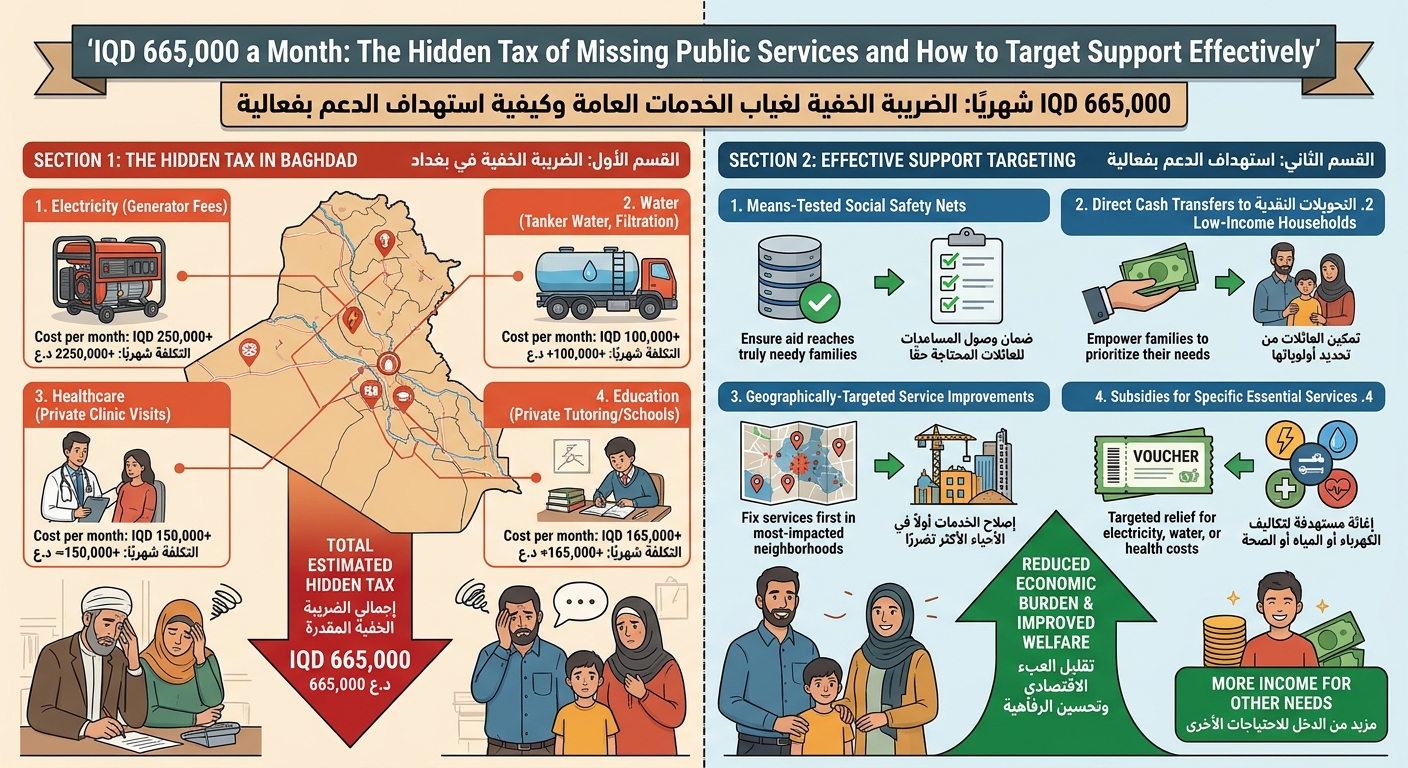
The average Iraqi household pays approximately IQD 665,000 out of pocket every month to compensate for deficiencies in seven essential services that the state is supposed to provide. This amount alone represents approximately 44% of the estimated minimum subsistence cost of IQD 1.5 million per month.
These services are healthcare, education, drinking water, electricity, municipal services, internet, and roads and transport. The figure excludes food, rent, and clothing.
This is the conclusion reached during a discussion examining the deterioration of these services, its underlying causes, and the amounts citizens spend to compensate for deficiencies in each area. More concerning is that this burden does not account for income differences: low-income and affluent households pay approximately the same amount.
This raises the central question addressed in this article: When resources are limited, how can support reach those who genuinely need it without leaking to those who do not?
Electricity: A Smaller Expense, but the Greatest Deprivation
Electricity does not account for the largest share of the IQD 665,000, but its impact on people’s lives is among the most severe. According to figures presented during the discussion, approximately 63% of the population experiences electricity deprivation during the summer.
The result is that a shortfall in one sector creates costs in another. Families in southern Iraq sometimes go to hospitals claiming to be ill when their actual purpose is to access several hours of cooling. Consequently, the Ministry of Health incurs higher operating costs because of the poor performance of the Ministry of Electricity, and public funds pay the price twice.
Participants emphasised that the underlying problem has two dimensions: insufficient electricity generation and inadequate delivery of electricity to households.
This is one of the clearest arguments for precisely targeted support. General subsidies distributed across all consumers do little for a household that cannot afford additional amperes from a private generator. Targeted assistance delivered directly to that household, identified by name and address, can make a meaningful difference.
What the World Says: Universal Subsidies Are Costly, While Targeted Support Is More Effective
The latest OECD reports point to a consistent conclusion: untargeted subsidies drain public budgets without adequately protecting the most vulnerable.
In its 2026 report, Restoring Public Finances, the OECD found that untargeted measures accounted for 77% of the cost of energy support during the 2022–2023 crisis. It drew three key lessons from this experience (OECD, Restoring Public Finances):
- Targeting the most vulnerable households reduces costs and increases impact.
- Every subsidy should have a publicly announced end date to prevent temporary assistance from becoming a permanent entitlement.
- Support should target incomes rather than prices, preserving incentives to conserve resources.
The report offers a practical tool: use existing social assistance registries as a fast channel for delivering support. These can then be developed into a system that classifies households according to their degree of vulnerability, taking into account income, age, illness, and geographical location.
Ireland’s fuel allowance provides an example of this approach, with eligibility determined by criteria including age, income, and household composition.
According to the same report, more than half of OECD member countries are tightening income tests when reviewing household support. Nearly all use spending reviews to identify duplication and waste.
Economists Rema Hanna and Benjamin Olken compared universal basic income programmes with targeted transfers in Indonesia and Peru. They found that targeting, despite its imperfections, can deliver substantially greater welfare gains because it allows more money to reach poorer households within the same budget (NBER).
The discussion’s concerns about the private sector are also supported by the OECD’s 2026 report, Smart Regulations, Strong Business (OECD, Smart Regulations):
- Business organisations in 90% of countries, and governments themselves in 72%, consider bureaucracy excessive.
- Small and medium-sized enterprises bear the heaviest burden.
- The main problem often lies in procedures and reporting requirements rather than in the substance of the law itself.
- In 70% of countries, businesses do not consider regulations to be consistent with one another. This is precisely what happens when multiple authorities compete to regulate the same sector.
The OECD’s 2026 report, The People and the Budget, links the success of fiscal reform to public trust. It identifies a 47-percentage-point trust gap between people who feel that people like them have a say in decision-making and those who do not (OECD, The People and the Budget).
This provides direct support for the recommendation to involve the private sector and experts in the economic decision-making process.
Consulting Firms’ Perspective: Protect People, Not Prices
In February 2026, KPMG, in collaboration with the World Governments Summit, released a report entitled Fiscal Surgery, examining subsidy reform. The report estimated that global subsidies amounted to approximately USD 7 trillion in 2022, equivalent to more than 7% of global GDP, with most of this support directed towards energy (World Governments Summit).
The report described untargeted subsidies as a burden on public finances that weakens incentives to conserve resources and disproportionately benefits higher-income households.
Its recommendations included:
- Gradual, sequenced reform rather than sudden increases.
- Direct protection for people through cash transfers or reduced tariffs for essential consumption, instead of suppressing prices for everyone.
- Transparent communication with citizens and effective institutional coordination among the relevant authorities.
- Redirecting savings towards infrastructure, education, and healthcare.
The report notes that Gulf countries have pursued this approach by linking fuel prices to international benchmarks, introducing tiered tariffs, and providing targeted social protection.
These conclusions reinforce the OECD’s findings. The question is no longer simply, “Should we provide subsidies or not?” It is: “Who should receive support, how should it be delivered, and for how long?”
The Iraqi Perspective: From a “Per-Head Tax” to Tiered Support
A Tax That Ignores Fairness
Mr Khalid Al-Jabri, Chairman of the Osoul Foundation for Economic Development and Sustainable Development, stated that IQD 665,000 represents the minimum amount every Iraqi household pays to compensate for the deterioration of the seven public services.
He describes this burden as a “per-head tax” because everyone pays approximately the same amount, regardless of income. As a result, it does not reflect differences in household resources or the principles of tax equity.
Al-Jabri explains that electricity accounts for no more than approximately 15% of this expenditure. The largest share, around 45%, goes towards healthcare and education because people turn to private providers to obtain these services.
He warns that more than half of households postpone medical treatment, allowing illnesses to worsen and resulting in substantially higher costs later.
A Four-Tier Household Classification: The Key to Targeting Support
Based on a survey conducted by the Osoul Foundation involving a sample of 500 households, Al-Jabri divides society into four tiers according to monthly household income:
| Household tier | Monthly household income |
|---|---|
| Vulnerable | Approximately IQD 750,000 or less |
| Financially strained | Approximately IQD 1.25 million |
| Self-sufficient | Approximately IQD 2 million |
| Financially secure | Approximately IQD 3.25 million |
According to the same sample, the vulnerable tier accounts for approximately 21% of households, while the vulnerable and financially strained tiers together account for roughly half.
This classification reflects the same principle advocated by the OECD: categorising households according to their degree of vulnerability.
Al-Jabri argues that the most vulnerable households must receive support regardless of the dollar exchange rate. He proposes two complementary approaches:
- Direct support: Food vouchers redeemable at shopping centres and lower private-generator subscription costs through the provision of subsidised kerosene allocations.
- Indirect support, which he considers particularly important: Reducing customs valuation through government action and granting tax exemptions on essential goods through parliamentary decisions.
Designing Support Is the Most Complex Part of the Challenge
Al-Jabri points out that European countries introduced approximately 60–70 support packages but fell into a common trap: households that did not need assistance also benefited.
For this reason, he considers the design of support programmes to be “the most complex task” today, while stressing that this complexity should not become an excuse for failing to introduce them.
This observation mirrors the OECD’s findings on untargeted subsidies, which accounted for 77% of the cost of energy support during the 2022–2023 crisis.
Al-Jabri adds that support should be financed through reforms and sound resource management, not through higher fees or taxes, which would undermine economic activity.
Reform Must Be a Complete Package
Al-Jabri compares certain reforms to a vaccine that causes temporary fever, which must be endured to achieve a longer-term benefit.
However, he insists that reform must be “one integrated package, not separate pieces.” Simply devaluing the dinar, for example, is like “putting a plaster over a wound” rather than treating the underlying problem.
Do Not Strangle the Sector That Provides Jobs
Regarding delivery companies, Al-Jabri notes that they are required to obtain two licences from separate authorities: the Postal Directorate at the Ministry of Communications and the Land Transport Directorate at the Ministry of Transport.
He estimates that the delivery sector supports at least one million jobs across its value chain, including traders, transporters, suppliers, and motorcycle owners.
Before imposing any additional regulatory burden, Al-Jabri raises a fundamental question: Does the state have the capacity to absorb one million workers who could lose their livelihoods?
He argues that restricting this sector would also constrain small businesses operating from people’s homes.
During a crisis, he maintains, taxes and customs duties should be reduced rather than increased.
This position aligns with the OECD’s findings that fragmented administrative procedures across multiple authorities place a disproportionate burden on small businesses.
From the Ground: Capital Flees Uncertainty, Not Taxes
The discussion’s warning about capital flight and the loss of employment opportunities is echoed by those who work with investors every day.
Investors are not charitable organisations. Their first concern is the stability of the rules, not the tax rate itself.
Tax evasion and capital flight are not necessarily caused by high taxes. The United Arab Emirates provides an