
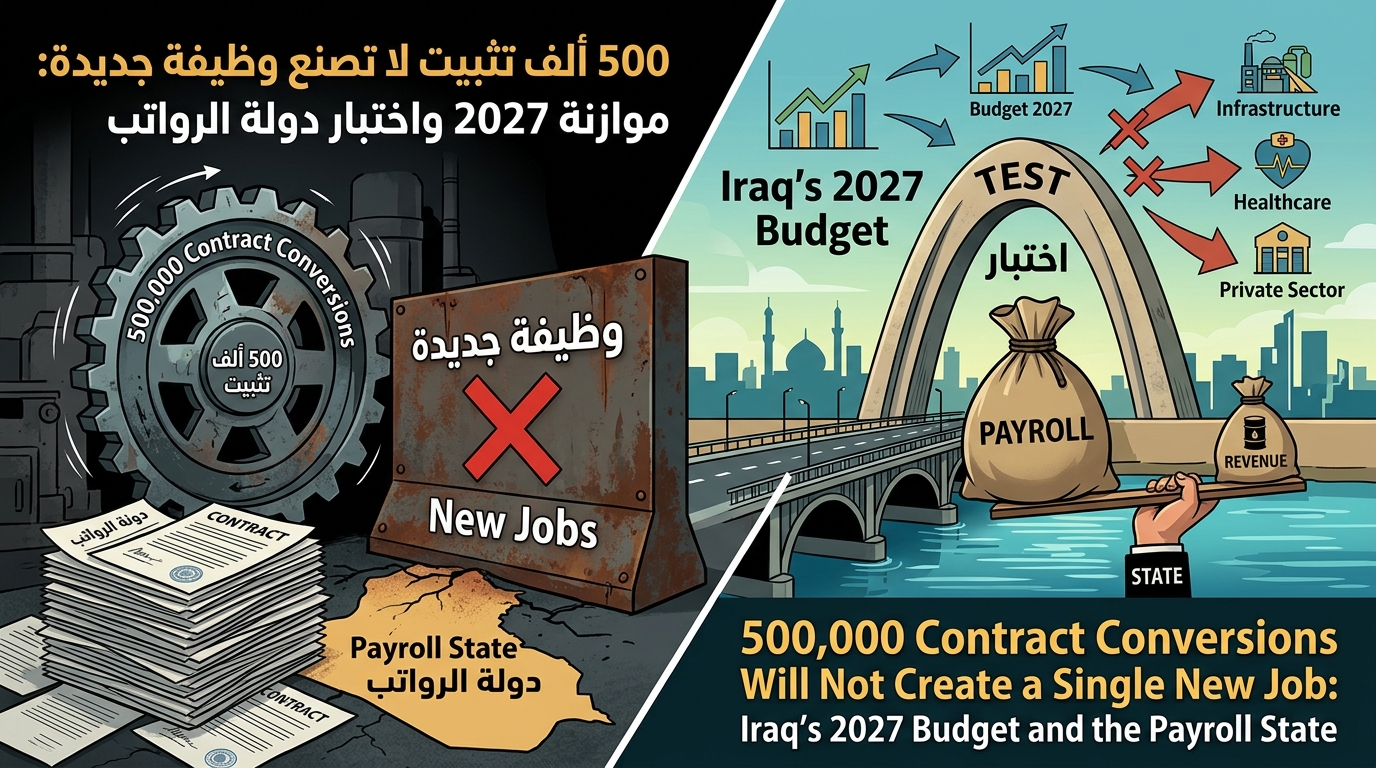
500,000 Contract Conversions Will Not Create a Single New Job: Iraq’s 2027 Budget and the Payroll State
Converting half a million temporary public workers into permanent civil servants rewards people who have waited years. It does not create a single job for the graduates who come next. That tension sits at the heart of Iraq’s 2027 budget, the largest in the country’s history.
Amounts are in Iraqi dinars (IQD), with dollar equivalents at the official rate of IQD 1,520 per US dollar set in October 2026.
The problem in numbers
On 24 October 2026, the government spokesman announced that the prime minister had directed the conversion of more than 500,000 contract and daily-wage workers to permanent posts. He also announced 120,000 new contract positions. Published draft figures put 2027 spending at about IQD 217.2 trillion (roughly $143 billion) against revenue of IQD 174.2 trillion. That leaves a gap of about IQD 43 trillion ($28 billion); parliament’s finance committee puts it nearer IQD 50 trillion.
Salaries alone account for IQD 64.7 trillion and social welfare for a further IQD 33 trillion, together about 45% of spending. The draft assumes oil at $58 a barrel, exports of 4 million barrels a day and an exchange rate of IQD 1,500. All this comes in a year when the IMF expects the economy to contract by 16% and foreign reserves have fallen from about $109 billion to $80.6 billion.
On 29 October the IMF said it had begun talks with Baghdad on a new financing programme. A day later the government denied reports that it planned to borrow IQD 16 trillion. Iraqis are asking a simple question: how will salaries be paid when, by the end of August, the state had spent IQD 78.9 trillion against revenue of only IQD 45.3 trillion?
Diagnosis: why hiring returns in every crisis
Public hiring in Iraq is less an employment policy than an informal social insurance scheme that distributes oil rent. It works through four linked channels:
- A private sector that cannot absorb. The Ministry of Planning puts unemployment at 13% and youth unemployment near 20%, with about 250,000 graduates a year from state universities alone. When firms do not hire, social pressure lands on the budget.
- Oil revenue pays the wage bill. Exports fell from 3.36 million barrels a day in February to 131,000 in April, after the Strait of Hormuz closed, then recovered to about 3.4 million at discounts of $25–30 a barrel. Any shock in the Gulf reaches the public employee’s pocket directly.
- Crowding out productive spending. Rigid spending consumes fiscal space, so operating inputs and investment shrink. The result is staff without tools and poor public services.
- Paying twice. Households make up for weak services with out-of-pocket spending on neighbourhood generators (private diesel generators that fill gaps in grid power), private schooling and private clinics. This erodes the very income that came from the public wage.
The trade-off is clear. Conversion stabilises the income of contract workers in the short term, but it turns flexible spending into a permanent obligation with pension rights. The cost falls on two groups absent from the debate: future graduates, and a private sector that must compete with a job guaranteed for life. The cost of the decision has not been published, although the finance ministry has counted the contracts and estimated it.
What the world says
A simple comparison shows the scale of the gap. According to the OECD’s Restoring Public Finances (2026), compensation of public employees accounts for 23% of general government spending in OECD countries. In Iraq’s draft, salaries alone are about 30% of spending (IQD 64.7 trillion of 217.2 trillion), before social welfare is counted.
The same report finds that about three-fifths of countries in its survey are reforming public employment, targeting its size, structure and pay. Canada offers the most complete model: a leaner public service that combines downsizing and renewal of the workforce with new tools, technology and training to raise productivity. The report also warns that average OECD spending is set to rise by 0.8% of GDP between 2024 and 2026, while revenue measures add only 0.3%. Even rich states lose the spending race when reform is piecemeal.
The OECD’s Smart Regulations, Strong Business (2026) supplies the other half of the equation. The share of new and young firms in employment has fallen by 6 percentage points since 2004 in selected countries. One driver is regulation that imposes fixed costs which penalise new and small firms disproportionately. The lesson for Iraq is direct: new private jobs are mostly born in small new firms, and those are the first victims of slow licensing.
Harvard economist Dani Rodrik goes further. Good jobs, he argues, need to be “productive – but not necessarily the MOST productive.” He calls for integrating growth, employment and social policy, focusing on middle-productivity activities such as domestic services, and using tailored business incentives rather than simple employment subsidies. That is what Iraq’s budget debate misses: a job is treated as a spending line, not as the outcome of economic policy.
Regionally, the IMF expects Kuwait’s economy to shrink by 16.7% and Qatar’s by 15.6% in 2026. The difference is that Iraq’s neighbours meet the shock with sovereign wealth funds, while Iraq meets it with a swollen wage bill and dwindling reserves.
The consultancy view
Oliver Wyman examined the same dilemma in the Gulf in Maximizing Employment of Nationals in the GCC (2018). It links part of the Gulf’s deficits to the cost of the public workforce and argues that a more balanced split between the public and private sectors brings fiscal gains and prepares citizens for competition. Its approach asks three questions: how to make private jobs attractive to nationals, how to make nationals attractive to private employers, and which skills they need. It pairs quick measures with broader economic reform. The report is dated, but its questions are Iraq’s questions today.
The Iraqi view: what Al-Jabri proposes
Mr. Khaled Al-Jabri, President of the Osoul Foundation for Economic Development and Sustainable Development, stated that talk of a crisis while hiring continues reveals a deeper crisis: it means “we do not know how to activate the private sector.” In his view the Iraqi economy “does not generate jobs,” leaving the state with only “rentier hiring.” This matches Rodrik’s diagnosis: public employment substitutes for a missing jobs policy.
Al-Jabri puts the budget to a blunt test. He estimates the state’s non-discretionary spending at about $125 billion. Exporting 3.5 million barrels a day, he calculates a deficit of about $46 billion at $50 a barrel, $32 billion at $60 and $17 billion at $70. Spending balances only at $85, and actual exports are below 3.5 million barrels.
| Theme | Global view | Al-Jabri’s Iraqi specificity |
| Size of public employment | OECD: reform size, structure and pay; Canada combines downsizing with renewal | Voluntary moves, not dismissals: an employee on IQD 800,000 (about $526) is offered IQD 2 million (about $1,316) with social security |
| Business environment | OECD: regulation penalises new and small firms | A factory licence in 72 hours and an investment licence in one week |
| Sequencing | Oliver Wyman: quick measures plus broader reform | Three phases: under 3 years, then 5–7, then 20 years |
| Role of the state | Rodrik: integrate growth, jobs and social policy | The state buys services rather than running them |
In the view of Mr. Khaled Al-Jabri, citizens “pay twice” for electricity, water, education and health. Households pump some IQD 30–36 trillion ($20–24 billion) a year into seven services where the state falls short. He calls for “re-engineering” this spending: the state should buy services from the private sector and regulate their quality, so jobs are created outside the civil service. Success, for him, comes when private pay is double public pay, triggering a “reverse migration” of workers.
Al-Jabri points to China, where public employees fell from 120 million to 74 million within five to six years as starting a company became almost free. He notes that Iraq’s education ministry spends 99% of its budget on salaries, while the global norm puts operating inputs at about 60% of the wage bill. In an earlier press statement he estimated the cost of one hour of government work at about IQD 37 billion ($24 million), adding that “time is paid for while results are absent.”
Al-Jabri agrees with the global diagnosis but adds an Iraqi condition: reform never accumulates, because each government disowns what its predecessor began. Hence he starts with incentives rather than restrictions, and makes the family, not the budget line, the target of fiscal policy.
Voices from the field
As guest Ismail Marqa, Senior Partner at PwC Iraq, said in the episode “العراق غني بثرواته الطبيعيه والبشرية والتنمية تكون بجودة ادارتها!” (Iraq Is Rich in Natural and Human Resources, and Development Depends on How Well They Are Managed!) of the Seed | Nmw podcast, in Britain’s health system the state owns no hospitals and employs no doctors; its role has become that of a regulator rather than an operator. He argues that reducing oil dependence starts with strengthening the private sector so it produces and eases the import burden.
As guest Saman Bojan, General Manager of Asiacell, said in the episode “كيف تحول قطاع الاتصالات في العراق” (How Iraq’s Telecom Sector Was Transformed) of the Seed | Nmw podcast, the private sector is “the only possible tool” for rapid transformation, provided there is a long-term government strategy that successive governments honour.
Recommendations
- Ministry of Finance: publish the cost of converting 500,000 contracts and creating 120,000 posts, with funding sources, before the vote, through a three-year fiscal-impact annex that includes pension liabilities.
- Parliament’s finance committee: add a budget clause tying every new post in service sectors to an allocation for its operating inputs.
- Council of Ministers, National Investment Commission and Ministry of Industry: adopt a 72-hour factory licence and a one-week investment licence, through a single digital window with tacit approval once the deadline passes.
- Ministry of Labour and the pension authority: open a voluntary path from public to private employment that preserves years of service, by making pension rights portable between the two systems.
- Ministries of Health and Education: pilot purchasing services from the private sector in two governorates, with performance contracts that tie payment to published quality indicators.
- Ministry of Planning: publish with each budget an indicator of new private-sector jobs, from the labour force survey, so success is measured by what the economy creates, not by what the state adds.
- The government in IMF talks: present wage-bill reform as a phased, three-stage Iraqi programme, in a national reform document binding on future governments, rather than waiting for conditions imposed from outside.
Conclusion
Contract conversion is an understandable social decision, but it is not an employment policy. If the 2027 budget passes without tools that create jobs outside the state, the 2028 budget will return to the same question with larger numbers. The opportunity now is to pair every dinar spent on salaries with a measure that makes a private job a real choice.
Sources
- OECD (2026), Restoring Public Finances: Enabling Effective Government — https://doi.org/10.1787/fbcf9161-en
- OECD (2026), Smart Regulations, Strong Business — https://doi.org/10.1787/93d38770-en
- Dani Rodrik (2021), “How can we generate more good jobs in developing countries?”, World Bank Jobs blog, republished by the World Economic Forum — https://www.weforum.org/stories/jobs-and-the-future-of-work/how-can-we-generate-more-good-jobs-in-developing-countries/
- Oliver Wyman (2018), Maximizing Employment of Nationals in the GCC — https://www.oliverwyman.com/our-expertise/insights/2018/oct/maximizing-employment-of-nationals-in-the-gcc.html
- Al-Mada (27 Oct 2026), Iraq’s 2027 budget the largest in its history despite the crisis — https://almadapaper.net/458539/
- The National (26 Oct 2026), Iraq’s biggest ever budget for 2027 — https://www.thenationalnews.com/business/economy/2026/10/26/iraqs-biggest-ever-budget-for-2027-built-for-boom-times-amid-economic-bust/
- 964 Media (24 Oct 2026), government spokesman on converting half a million contracts — https://964media.com/728820/
- 964 Media (29 Oct 2026), IMF begins talks on a rescue programme for Iraq — https://964media.com/731078/
- 964 Media (30 Oct 2026), government denies IQD 16 trillion borrowing — https://964media.com/731276/
- Shafaq News (13 Oct 2026), IMF: Iraq’s economy to shrink 16% in 2026 — https://shafaq.com/en/Economy/IMF-Iraq-s-economy-to-shrink-16-in-2026
- Shafaq News (20 Feb 2026), graduate unemployment, citing the Ministry of Planning
- Eishan (13 Dec 2025), cost of an hour of government work