State-Owned Enterprises: Profitable Assets Abroad, a Budget Burden in Iraq
Same owner, opposite results
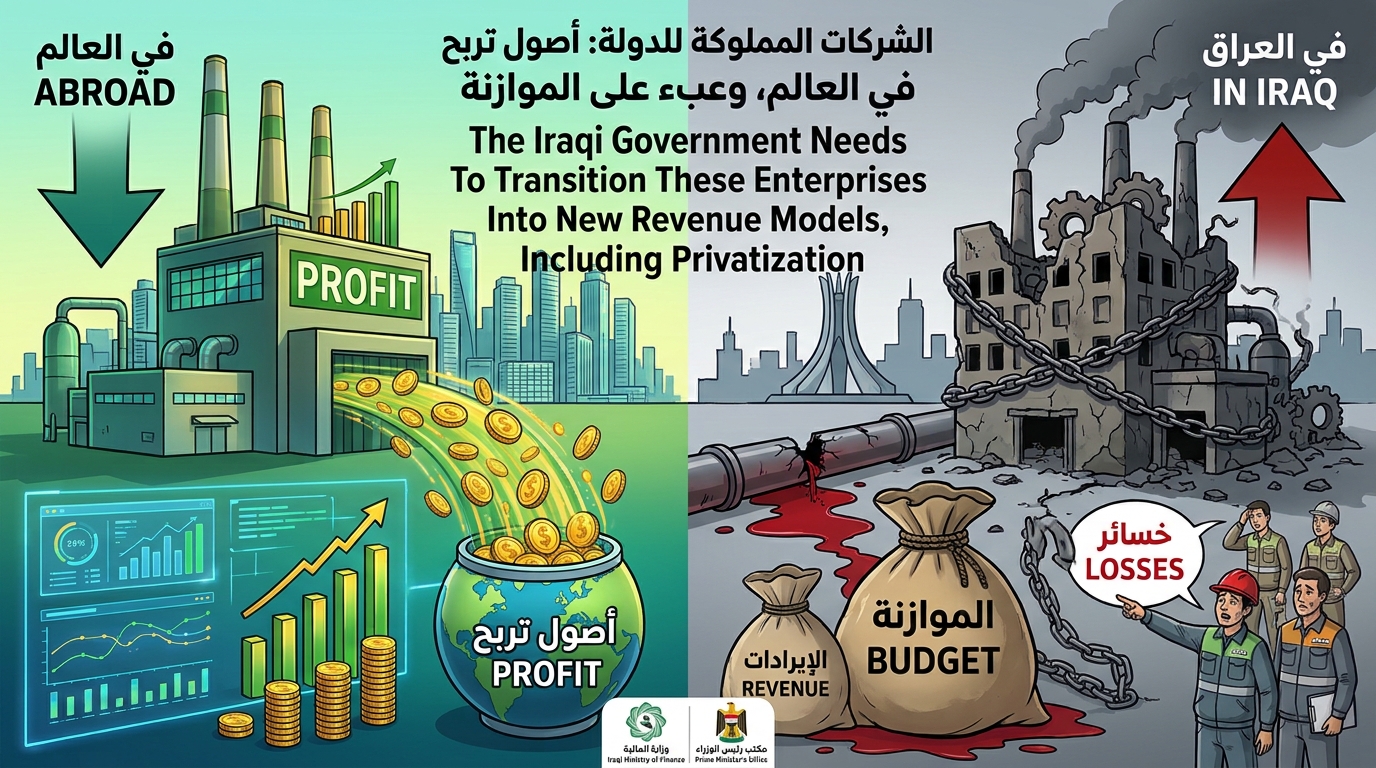
States own companies everywhere, Iraq included. The difference lies not in who owns them, but in how what is owned is managed — and to whom management answers.
In October 2026 the OECD launched Ownership and Governance of State-Owned Enterprises 2026. It shows that some 33,800 state-owned enterprises worldwide hold assets of $141 trillion — 126% of world GDP — and employ 43 million people (2024). They are not more profitable than private firms: their average return on equity was 4.7% against 6.4% for comparable private companies over 2013–24. But they do make money, and they pay the treasury under published rules.
In Iraq the picture is reversed. The state owns 192 public companies; in a recent study covering 159 of them, 95 — roughly 60% — were loss-making and survived on treasury grants. In 2023, grants and subsidies to these companies reached about IQD 20.4 trillion (roughly $13.4bn at the current official rate of IQD 1,520 per dollar), against profits paid to the treasury of only about IQD 1.7 trillion (≈$1.1bn). For every dinar that comes back to the state, about 12 go out.
Even the profitable ones do not always pay up. In July 2026 a report by Iraq’s Federal Board of Supreme Audit showed public companies had not paid the treasury its share of their profits — Basra Oil Company alone owed about IQD 2 trillion (≈$1.3bn). What explains the gap?
The question arrives at a critical moment. On 26 October 2026 the Ministerial Council for the Economy formed a ministerial committee to review the state of public companies and assess their performance. The same week, the draft 2027 budget put salaries at IQD 64.7 trillion (≈$42.6bn) and the deficit at nearly IQD 43 trillion (≈$28.3bn), alongside a directive to give permanent status to more than 500,000 contract and daily-wage workers. Every dinar spent covering an SOE’s losses comes out of a budget that is already overstretched.
The difference in one table
The OECD Guidelines on Corporate Governance of State-Owned Enterprises (revised 2024) set the benchmark for the global model. Set against Iraqi practice, the gap appears line by line:
| Item | Global model (OECD Guidelines) | Iraqi case |
| Why the state owns | A published rationale for each company, reviewed periodically | Inherited ownership with no stated rationale; most founded as monopolies |
| Who owns | A central ownership entity separate from the regulator | The line ministry owns, regulates and operates at once |
| Competition | Level playing field: same taxes, laws and market-based finance | A separate law (No. 22 of 1997) and losses covered by the treasury |
| Public-service duties | Costed and funded separately and transparently from the budget | Mixed into commercial activity; employment itself becomes a social function |
| Board | Merit-based, with independent members; appoints and dismisses the CEO | Ministerial appointment; real decisions taken outside the company |
| Disclosure | Listed-company standards, plus an aggregate annual portfolio report | No aggregate report; figures come from auditors and independent studies |
| Profits | A published dividend policy and returns that cover the cost of capital | Profits mostly from oil companies, with trillions in arrears to the treasury |
Two caveats in fairness. First, state-owned enterprises worldwide are no ideal model: they are less profitable than private firms and more leveraged (about 62% of assets against 58%), and firms more than 25% state-owned receive significantly more industrial subsidies than their competitors. Second, roughly half the world’s countries have yet to apply the model in full.
So the difference is not between companies that profit without support and companies that lose with it. It is that support there is deliberate, disclosed and tied to a goal, and returns are positive and measured — while here it is a standing, unaccounted cover for losses.
Diagnosis: four channels that turn assets into liabilities
Channel one: founded as monopolies, then exposed to open markets. Most Iraqi industrial SOEs were built for a closed economy. When imports opened after 2003, they found themselves with higher costs and outdated technology facing cheaper rivals.
Channel two: employment instead of production. Regularising contract and daily-wage workers raised wage costs, especially in the industry and electricity ministries. Losses are concentrated in Industry (26 of 29 companies loss-making), Electricity (14 of 14) and Construction and Housing (7 of 7).
Channel three: a soft budget constraint. A company that knows the treasury will cover its losses has no incentive to cut costs or improve collection.
Channel four: blurred roles. The same ministry owns the company, sets market rules and appoints management. No one holds anyone to account, and commercial decisions bend to political and social considerations.
The fiscal result is doubly costly. Grants to loss-makers rose by about 213% between 2016 and 2023 — oil money going to wages rather than investment — while SOE profits contribute no more than about 2% of public revenue. That is why the IMF, in its 2025 Article IV consultation, called for stronger accountability frameworks for state-owned enterprises in oil, electricity and construction.
What the world says: a good owner, not ownership itself
The global model rests not on privatisation but on separating roles. The OECD’s survey of 58 countries shows the road is still long even for others:
| Practice | Share of countries applying it | Iraq |
| A single, published state ownership policy | 43% | No |
| Ownership separated from regulation and policymaking | 42% | No |
| The same legal framework for state-owned and private firms | 57% | No (two separate laws) |
| A minimum share of independent board members | 54% | No |
| Politicians barred from boards | 45% | No |
| Independent external audit | 93% | Partly, through the Federal Board of Supreme Audit |
| Dividend guidelines / a binding minimum payout | 49% / 32% | A treasury share, with large arrears |
Countries further along offer specific, transferable tools:
- A central holding company: Austria pools its companies in a commercially run holding (ÖBAG); Indonesia created the Danantara holding under a new law in 2025.
- The closest Arab model: Morocco moved state ownership to a specialised national agency, with a published shareholding policy and a 2023 law requiring at least one independent member on every board.
- Tax neutrality: in Australia, state-owned firms calculate income tax as if they were private and pay it.
- Binding dividend rules: Latvian SOEs pay out at least 70% of annual profits, rising to 90% in 2026–28; in Ireland the floor is 30%.
- Public disclosure: South Korea publishes its public institutions’ performance on a central platform (ALIO), and Brazil keeps a public electronic register of all state-owned companies.
In our region, the OECD has estimated that SOEs account for roughly half of economic activity in the Middle East and North Africa, and that Gulf sovereign wealth funds improved their governance because they sit apart from ministries and are less exposed to political decisions. That is the core difference between the Gulf and Iraq: there the owner is an investment fund; here it is a ministry.
Economists Dag Detter and Stefan Fölster, authors of The Public Wealth of Nations, reach the same conclusion. Writing on the IMF’s public financial management blog, they called the “privatise or nationalise” debate a quarter-century phony war, arguing that what matters is the quality of asset management, not the identity of the owner.
Malaysia offers practical proof. After an SOE reform programme launched in 2004, the market value of its government-linked companies tripled by 2014 and their return on equity approached that of listed firms. The tools were published performance indicators, managers drawn from both public and private sectors, and an academy to train board members.
More broadly, the 2024 Nobel Prize in economics went to Daron Acemoglu, Simon Johnson and James Robinson for their research on how institutions shape prosperity. The state-owned company is the clearest test of that idea: the same asset profits or loses depending on the institution that manages it.
The consultancies’ reading: conflicting goals and political interference
McKinsey found that average return on assets at Chinese SOEs was less than half that of the private sector. It traced this to protection from competition, conflicting objectives, political interference and promotion by seniority rather than performance — the very causes visible in Iraq. Its remedy: a financial target first that covers the cost of capital, social objectives explicitly funded by the state, and pay linked to performance.
PwC starts from the premise that SOEs are here to stay, and that the question is what public value they add. It therefore calls for a clear mission and a performance scorecard for each company.
In Iraq itself, the experiment has begun with state banks. In February 2025 EY was commissioned to carry out a full assessment of state-owned banks, and Oliver Wyman to conduct a study within the restructuring plan. In January 2026 a plan was announced to split Rafidain Bank into a sovereign bank for treasury operations and a mixed joint-stock company for lending. That is exactly the OECD principle of separating sovereign functions from commercial activity. The question now is why the same model is not extended to industrial companies.
The Iraqi view: from operating assets to investing in them
Mr. Khaled Al-Jabri, President of the Osoul Foundation for Economic Development and Sustainable Development, stated that “the owner of the asset — the state — is the one who made it fail”. The state does not hold its companies to taxes or customs duties, covers their losses and hires into them. That is the literal opposite of the OECD’s level playing field. Listing these assets through a public offering, he argues, would turn society into a shareholder and a watchdog that appoints the board and the CEO and holds them to account.
Al-Jabri distinguishes between two kinds of assets. A low-value asset can be sold to buy a higher-yielding investment. But an asset that “lacks management” calls for the state to move from operating the asset to investing in it — bringing in a management partner who runs it and shares the profits, while the asset remains state property. His example is the land of the State Company for Leather in Baghdad’s Karrada district: about five and a half dunams that he values at over $150 million at market prices, yet which, if sold, would cover only about six hours of government spending. Selling assets to fund current spending, in his view, is a double loss.
He goes to the root of the problem: these companies were “a mistake at the moment of their founding”, profitable while they were subsidised monopolies without rivals, loss-making once competition arrived. He endorses a calculation raised in the same discussion: the state has spent about IQD 22 trillion (≈$14.5bn) on them since 2003, and had it sold them for one dinar, that sum would still be in the treasury. Yet he stresses that he opposes selling as a principle, because the companies’ land and facilities are “the assets of 46 million people”.
His alternative is to separate the property from the company:
- Land and facilities stay with the state: leased to the investor, not sold — in his example, at a quarter of their value.
- The investor takes the licence and the concession: such as the right to run a cement plant — and holds the decisions, not the state. This, Al-Jabri says, is what Egypt, Lebanon, Tunisia and Morocco did.
- An equation for employees: the more existing staff the investor retains, the lower the rent it pays.
Al-Jabri contrasts this with what happened in electricity, where bill collection was outsourced to private firms: that, he says, is “collection, not privatisation”.
He also calls for a level playing field: either abolish the privileges of public companies in trade and industry, or grant the private sector the same, since Public Companies Law No. 22 offers advantages absent from Companies Law No. 21. In fairness, a representative of the trade ministry’s companies replied in the same discussion that they enjoy no customs exemption and compete like the private sector — suggesting that privileges vary by sector and need a published inventory.
Where does Al-Jabri add an Iraqi specificity? In separating land from licence. Iraqi SOEs sit on valuable urban land worth more than their operations; separating the two protects the asset from a fire sale while opening the business to private management.
From the field: expertise is available, the decision hesitates
Gulf states drew on the major consultancies to transfer expertise and technology and to help shape economic policy. In Iraq there is strong resistance to change, the government remains “shy of approaching” these firms, and their work requires legislation — as guest Qutaiba Zaki, Senior Manager at Deloitte Middle East – Iraq, said in the episode “السياسات الضريبية في العراق بين التعقيد والرقمنة!” (Tax Policy in Iraq: Between Complexity and Digitisation!) of the Seed | Nmw podcast.
Family businesses — the closest local analogue to an owner who interferes in management — offer a clear lesson. A company survives and grows when it writes long-term internal policies, including fixed rules for appointing managers and staff and keeping owners out of key operational roles — as guest Haider Abdul-Ilah Al-Omran, Chairman of Al-Omran Group for Building Materials Trading, said in the episode “قطاع البناء – صرف مرتفع وجودة مفقودة و مواطنين متضررون!” (The Construction Sector: High Spending, Missing Quality and Harmed Citizens!) of the Seed | Nmw podcast.
Replace “family” with “ministry”, and you have the same rule the OECD sets for SOE boards.
Recommendations: six steps to close the gap
The committee formed by the Ministerial Council for the Economy is a chance for the review to deliver more than a status report. Six steps would make it count:
- A published inventory and classification (the ministerial committee with the Ministry of Finance, within six months): a written rationale for owning each of the 192 companies, sorted into strategic assets kept by the state, commercial firms run on market terms, and dormant firms whose licences are granted as concessions — published in a public electronic register, as in Brazil.
- One ownership policy and one ownership entity (the Council of Ministers, then the Council of Representatives): a holding company or shareholding agency established by law, on the Moroccan, Austrian or Indonesian model, to which ownership of commercial firms is transferred. Ministries remain regulators, not owners.
- Separate the asset from the operator (the ownership entity with the National Investment Commission): land and facilities stay with the state and are leased; the licence and management control go to a partner through open competition, with rent linked to the number of existing staff retained.
- Competitive neutrality (the Council of Representatives): amend Public Companies Law No. 22 of 1997 so that commercial SOEs face the same taxes, customs, bankruptcy rules and financing terms as the private sector, with an Australian-style tax equivalent.
- Price public-service obligations and set a dividend rule (Ministry of Finance, from the 2027 budget): fund any social role the state requires through a separate budget line instead of open-ended grants; set a binding minimum payout for profitable firms on the Latvian or Irish model, with a timetable for clearing arrears.
- Merit-based boards, annual disclosure and listing (the ownership entity and the Iraq Securities Commission): independent members and no political office-holders on boards, a public disclosure platform on the Korean ALIO model, then listing stakes in successful commercial firms on the Iraq Stock Exchange, so that citizen shareholders become watchdogs.
Conclusion
The difference between the world and Iraq is not that the state owns there and not here. It is that there the state is a shareholder holding a board accountable for a published return, while here it is an operator covering losses with oil money.
At a time when salaries and the dinar are squeezing the budget, Iraq can no longer afford to spend more than IQD 20 trillion a year on companies that could be a source of non-oil revenue. The assets exist, and they belong to 46 million Iraqis. What is missing is an owner that manages them as an investor.
Why Osoul?
The Osoul Foundation for Economic Development and Sustainable Development is an Iraqi institution that links data to economic decision-making. It combines monitoring of the Iraqi street, measurement of what people and businesses report, and comparison with leading international practice to produce actionable solutions.
- Daily monitoring and the weekly Iraq Economic Observatory: tracking what Iraqis are discussing on the economy and services, and government decisions, linked to regional and global context.
- Surveys and indicators: the Business Outlook Survey, the Service Gap Burden Index, and periodic surveys built on established international survey methodologies.
- Knowledge from the field: a documented library of economic positions, and the Seed | Nmw podcast, which interviews leaders of Iraqi companies.
- Workshops and policy briefs: workshops with research centres and stakeholders whose outputs become recommendations for decision-makers.
- Advisory and technical services for major companies and government agencies: data-driven studies, diagnostics and reform proposals, including economic-reform concept papers prepared for decision-makers.
The foundation’s outputs are available on its official website, www.ofesd.com, and its social media accounts.
Sources
- OECD (2026) — Ownership and Governance of State-Owned Enterprises 2026
- OECD (2024) — Guidelines on Corporate Governance of State-Owned Enterprises
- OECD (2026) — OECD MAGIC Database of Industrial Subsidies
- IMF (2025) — Iraq: Concluding Statement of the 2025 Article IV Mission
- Al-Baidar Center for Studies and Planning (2025) — Evaluation of Public Sector Companies in Iraq and Their Impact on the General Budget
- Hathalyoum (26 Oct 2026) — Ministerial Council for the Economy forms committee to review public companies (Arabic)
- Al-Mada (27 Oct 2026) — The 2027 budget, the largest in Iraq’s history despite the crisis (Arabic)
- AGBI (2026) — Iraq finds $18bn owed to state by government-owned companies
- Gulf News — Better governed state-owned enterprises to drive Gulf growth
- Dag Detter & Stefan Fölster, IMF PFM Blog (2015) — Public Ownership of Commercial Assets: A Quarter Century Phony War
- World Bank — Transforming state-owned enterprises: What other countries can learn from Malaysia
- News24 (2024) — Nobel economics prize goes to researchers of prosperity
- McKinsey — Improving performance at state-owned enterprises
- PwC — State-Owned Enterprises: Catalysts for public value creation?
- AGBI (2025) — Oliver Wyman joins EY in Iraq bank restructuring
- AGBI (2026) — Iraq explores overhaul of largest state-owned lender